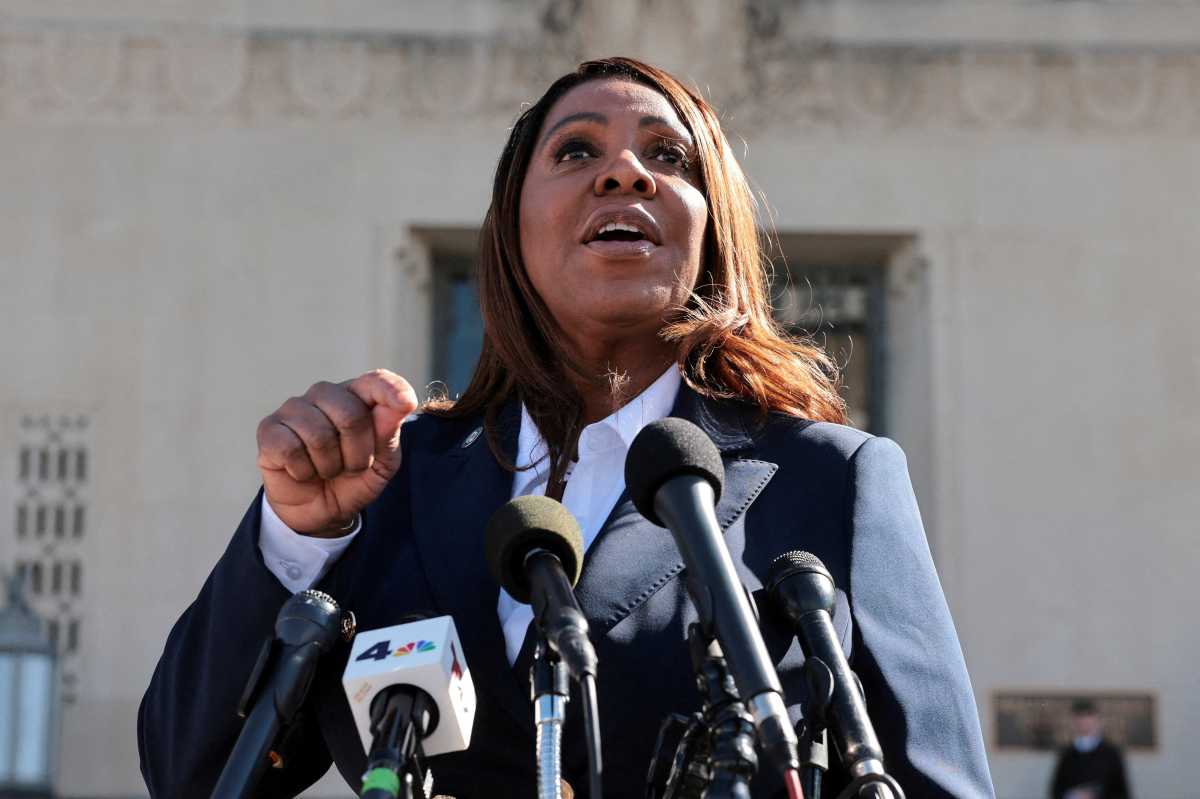
New York Attorney General Letitia James on Thursday, March 5, led a coalition of 21 other attorneys general and the governors of Kentucky and Pennsylvania in suing to stop the latest attempt by the Trump administration to impose sweeping tariffs that result in increased taxes on states, businesses, and consumers.
Shortly after the Supreme Court ruled in favor of Attorney General James and 11 other attorneys general who sued to stop the president’s “illegal” tariffs imposed under the International Emergency Economic Powers Act (IEEPA), the president issued a new proclamation imposing tariffs on a range of countries and goods using Section 122 of the Trade Act of 1974.
Attorney General James and the coalition argue in their lawsuit that these new tariffs are illegal because the president does not have the power to impose them.
“The tariffs do not meet the requirements of Section 122 and violate the Constitution’s protection of the separation of powers,” they said.
James and the coalition are seeking a court order declaring the tariffs imposed under Section 122 unlawful and ordering the federal government to issue refunds to states for the tariff costs that they paid as a result of the president’s proclamation.
“Once again, President Trump is ignoring the law and the Constitution to effectively raise taxes on consumers and small businesses,” said Attorney General James. “After the Supreme Court rejected his first attempt to impose sweeping tariffs, the president is causing more economic chaos and expecting Americans to foot the bill.
“These tariffs will only drive up the cost of living, and I will continue to uphold the rule of law to protect New Yorkers,” she added.
“The Trump administration’s illegal and reckless tariff policies continue to weigh on the businesses, farmers, and consumers across New York State, hindering the state’s overall economy,” said Gov. Kathy Hochul. “It is time the federal government refunds the $13.5 billion taken from hardworking New Yorkers and end the economic chaos that these unlawful taxes have created. I applaud Attorney General James for fighting for New Yorkers and look forward to continuing to work with her to put money back into the pockets of our families and workers.”
James said no president has ever attempted to impose tariffs using Section 122.
She said the law is specifically designed to allow limited tariffs to address certain monetary crises, including a significant “balance of payments” deficit — “a distinct economic problem that can occur in a fixed-rate exchange system like the gold standard.”
However, James said the US abandoned such an exchange system half a century ago.
As a result, James said balance of payments problems no longer occur.
Attorney General James and the coalition assert in their lawsuit that the president’s primary rationale for imposing these tariffs — the country’s trade deficit — is not a legitimate reason for imposing tariffs under Section 122.
In fact, they note that the administration admitted during the lawsuit against the president’s IEEPA tariffs that trade deficits “are conceptually distinct from balance of payments deficits.”
In addition, the coalition says the president’s tariffs violate other requirements in Section 122.
It says the law requires new tariffs to be applied consistently in several ways, including that they are not applied discriminatorily.
Yet, the coalition argues that the new tariffs exempt many goods from Canada, Mexico, Costa Rica, the Dominican Republic, El Salvador, Guatemala, Honduras, and Nicaragua. They also include 84 pages of specific product exceptions, the coalition says.
James and the coalition argue that the president’s use of Section 122 is “a clear attempt to escape the Supreme Court’s ruling in the case against the tariffs imposed under IEEPA.
“Like the previous ‘emergency’ tariffs, the president invoked Section 122 to impose sweeping tariffs on a whim with hardly any stated reasoning,” the coalition argues.
It notes that the proclamation first announcing the new tariffs was published on Feb. 20, two days after the Supreme Court ruling.
Attorney General James and the coalition argue that these sudden swings in tariff policy create significant costs for states, which must expend resources determining how these new costs will apply and how to handle soaring prices from vendors.
They say the “erratic swings” in tariff rates have also created new administrative costs for states, as agencies must piece together official policy from social media posts, executive orders, proclamations, and other sources.
In their lawsuit, Attorney General James and the coalition argue that the tariffs violate the Constitution’s separation of powers principle.
“Article I clearly gives Congress the power to tax and impose tariffs, and the president does not have the power to impose these kinds of sweeping tariff increases,” they said.
The lawsuit seeks an order from the United States Court of International Trade declaring the Section 122 tariffs illegal and preventing them from being implemented, as well as an order to refund the states the costs of these tariffs while they were in effect.
Joining Attorney General James in filing this lawsuit are the attorneys general of Arizona, California, Colorado, Connecticut, Delaware, Illinois, Maine, Maryland, Massachusetts, Michigan, Minnesota, Nevada, New Jersey, New Mexico, North Carolina, Rhode Island, Oregon, Vermont, Virginia, Washington, Wisconsin, and the governors of Kentucky and Pennsylvania.