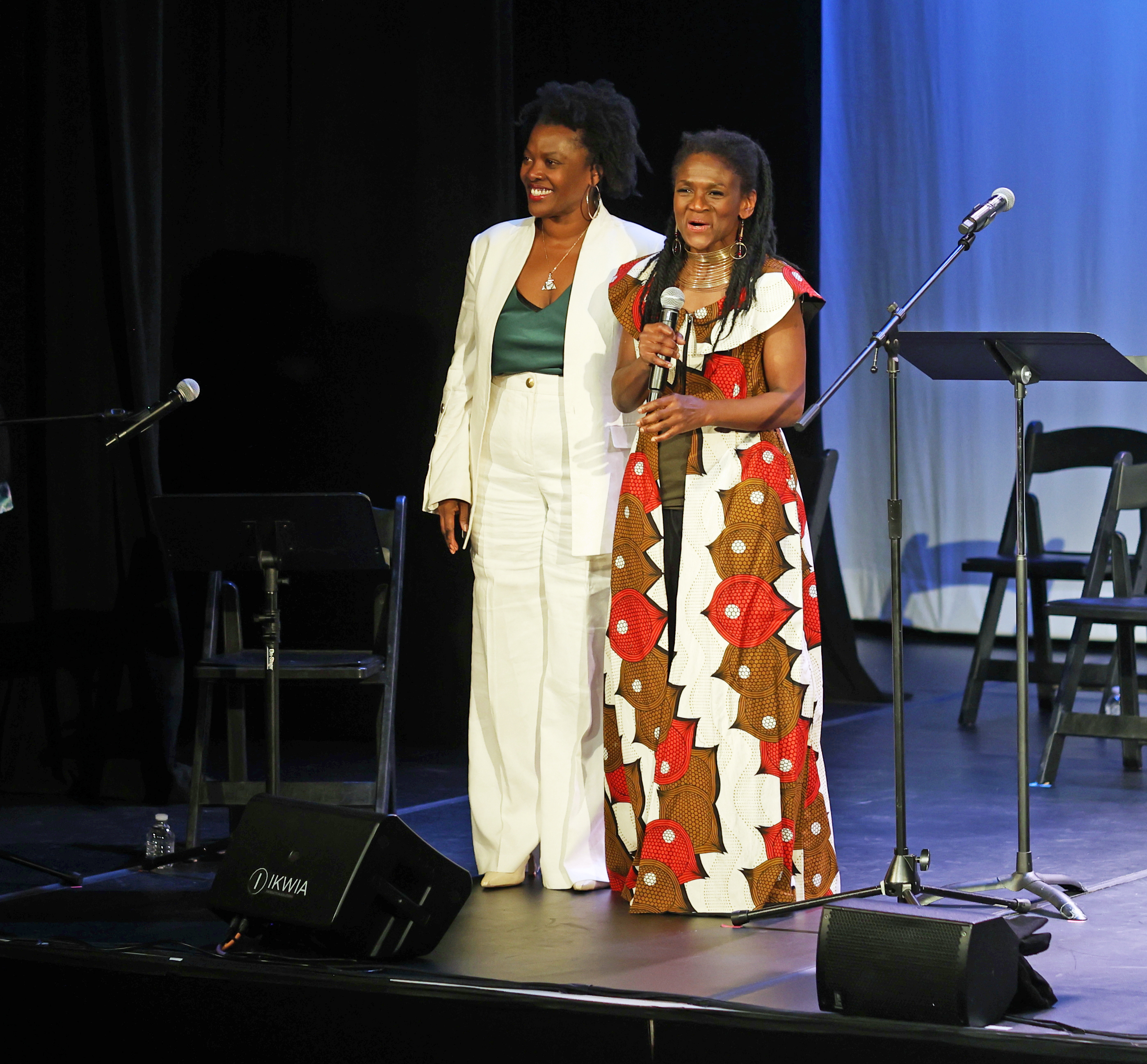
On Dec. 13, the Billie Holiday Theater launched its one-night Caribbean Theater Festival, Caribbean Calling: Roots & Resurgence, which was curated by Obie Award-winner Heather Alicia Simms and Drama Desk Award-nominee Patrice Johnson Chevannes.
The festival highlighted seminal and contemporary works from the English-speaking Caribbean, including works created by playwrights such as Mustapha Matura, Derek Walcott, Una Marson, Sistren Theatre Collective, and they were performed by an acclaimed cast of Caribbean and Caribbean-American actors.
The evening also featured a dynamic discussion moderated by Kamilah Forbes, executive producer of The Apollo, with a powerhouse panel including Karl O’Brien Williams, artistic director of Braata Productions; Patricia McGregor, artistic director of New York Theatre Workshop; Nicole Watson, producing artistic director of Playwrights’ Center; and Lamar Richardson, Tony Award®–winning producer & actor.
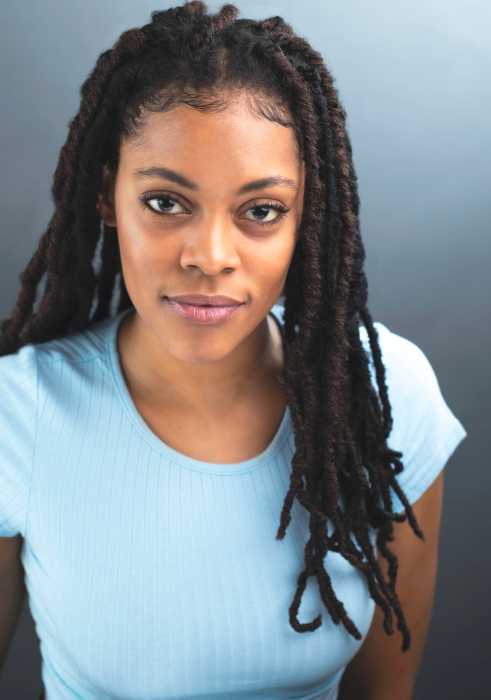
Simms and Chevannes spoke with Caribbean Life about the journey that led to their collaboration in curating this festival. It might surprise people to know that Simms was the first person on either side of her family born in the United States. It may also surprise people that Chevannes is a cat rescuer, and she has gotten over 30 cats adopted.
“What makes this particularly surprising is that I was born in the Caribbean, where my only connection with cats or kittens growing up was seeing them being shooed from gardens or steps. Animals stayed outside there,” Chevannes added.
Simms was born in the East Flatbush neighborhood of Brooklyn, while Chevannes was born in Jamaica, and both are part of large families. On what life was like growing up, Simms shared that she always felt like she had family around, as many of them would stop at her family’s home first as they started their new life in this country.
“It was always exciting to go home to Jamaica and see cousins and then know that you had the opportunity to spend even more time with them in your own home in America. There was always a gathering, whether it was with family or with my father’s alma mater, The Mico Old Students Association, or whatever public interest groups my parents were members of; I was surrounded by groups of people who were determined to make a lasting impact,” she said.
Chevannes’ childhood was different, as her father stayed in Jamaica, leaving her mother to raise nine children as a single parent. They lived in the Frederick Douglass projects in New York, near the Vanderveer projects in East Flatbush, in Section 8 housing.
“She sent all her children to school by day, studied and worked by night to get re-qualified as an RN in America. However, my mother never allowed us to adopt the mindset that we lived in Section 8 housing. We were always going to reach for the skies. Life there shaped my determination and resilience, which have served me throughout my career,” said Chevannes.
Something that had the greatest impact on Simms’ career path as an actor was Sunday dinners with her family.
“That was a time when we set the table and could expect anyone from our large extended family to come eat, drink, and take part in the liveliest conversations. As children, we weren’t excluded from the conversation, and our nascent points of view were regarded and debated as if we held high degrees in the school of life. What I realized was that everyone had a story to tell and a unique way of telling it. I was fascinated by the stories and the storytellers and often wanted to hear the stories again,” Simms explained.
Chevannes was supposed to be an aerospace engineer, and she went to Cornell University in New York. It wasn’t until about halfway through her engineering degree at Cornell that she realized she was dissatisfied and unhappy with it, and secretly wanted to investigate acting.
She sees her mother, my family, and the Lord as the greatest influences in her path. Her mom and family supported her when she made this dramatic career change.
“If you don’t have family support, or a deep spiritual connection, or some kind of village, it is tough to do this business, especially when it doesn’t take off immediately. You need support to withstand the no’s, which can be interpreted as rejection. You need people to remind you who you are before you are an actor, to remind you of your uniqueness and your power, to hold your hands, pray for you, and tell you to keep going—you can do this,” she stated.
Then, Simms and Chevannes discussed how their careers began, with Simms sharing that she attended graduate school and received an MFA in Theater from Columbia University, at her father’s urging.
“Upon graduation, I started to audition and landed a play that was written by Kia Corthron and then an episode of a television show called Homicide: Life on the Street. Charles S. Dutton played my dad in that episode, and then a few years later, I played opposite him and Whoopi Goldberg in my first Broadway play, Joe Turner’s Come and Gone,” she stated.
For Chevannes, her journey began when she applied and was accepted into an acting program at City College, where she was taught by some of the greatest creatives in the business: Trazana Beverley, Robbie McCauley, Laurie Carlos, and Kristin Linklater.
“I had gone to work in Kristin Linklater’s company called the Company of Women. We were in Massachusetts for training, and we ultimately performed Henry V. I then received a call to audition for The Public Theater. Previously, I had auditioned for Shakespeare in the Park at the Delacorte. When somebody dropped out of a play they were doing for the summer, — All’s Well That Ends Well — I was called to come back and do my monologue for the director. I did it, I nailed it, and that began my acting career,” Chevannes explained.
Discussing how their unique experiences led the women to curate the festival together with Chevannes, Simms said that this idea developed after they received a grant from the Fox Foundation to investigate Jamaican theater practice in the diaspora several years ago.
“One of the great desires that I had was to create a festival that would expose those voices to an American audience. That desire remained, and it was something that Patrice and I often discussed. When we were approached by Laura Greer to think about curating such a festival, I knew that my desire to see this come to fruition hadn’t been for naught,” she added.
Chevannes continued to work in New York City, both off-Broadway and on Broadway, as well as occasionally in regional theater, performing in notable productions such as playing Desdemona to Sir Patrick Stewart’s Othello and sharing the stage with Liam Neeson and Laura Linney in the Broadway production of The Crucible.
For her, these experiences gave her the expertise, network, and vision to curate the Caribbean Theatre Festival. “Working at the highest levels of theater taught me what excellence looks like and how to bring that same standard to celebrating Caribbean voices,” she continued.
In addition, Chevannes said that curating this Caribbean theater festival was expansive, as she and Simms worked closely with Laura Greer, one of the producers at the Billie Holiday Theatre, because they first had to decide on the themes to focus on.
“In this case, it was to pay homage to our Caribbean playwright greats in the section we call ‘Roots’ and also lift up newer Caribbean voices and Caribbeans in the Diaspora, like Winsome Pinnock, in the section we call ‘Resurgence,’” she added.
On her experience curating the festival, Simms stated. “The opportunity to read new and old plays is my happy place. I had the privilege of working with my friends and dreaming about what a moment like this could look like. I was curating this festival with my cousin Patrice, and so I was able to dream with someone who I know shared the same passion for this work as I do.”
For Simms, having this production with a full cast of actors of Caribbean heritage is a dream, especially now, when immigration is one of the most important issues in the country.
“It was important to me for these stories to be heard in the most authentic way possible. The immigration debate isn’t a new one. Aside from the Native Americans who are indigenous to this land and the Africans who were trafficked to these shores, everyone else migrated in one way, shape, or form. We are distinct in accent, syntax, culture, food, and many more things, and in spite of what is going on in this country, we are shining a light on it and celebrating it. This is not the time to hide. Our numbers are our strength,” she continued.
Chevannes expressed a similar sentiment, stating, “Art can speak poignantly to current affairs and shine a light on issues. To have these excerpts from various Caribbean countries spoken by elite actors with the appropriate and specific accents is hugely important.”
For example, she mentioned the Trinidadian play by Mustapha Matura. It is cast with Trinidadian actors, and according to her, they are actually inside the pocket of the meaning — the rhythm of the language and the culture.
What legacy do you want to have in life? In what ways do you want to inspire younger generations in communities in New York and the Caribbean overall?
Simms wants her legacy to be one of inclusion, and she wants people to know that if they have a desire to do something, they need to believe they can achieve it.
“Faith without works is dead, so if you know that you need help in the direction that you want to go, then ask for the help. As far as my Caribbean community is concerned, we have numerous untapped resources within our communities. Our greatest strength is in our unity, and once we truly understand that, we will be unstoppable,” she continued.
Chevannes added to this and stated that she and Simms want to “inspire the current, older, and younger generations in New York to: write, to create, to not take no for an answer, to dream, to elaborate, to insist on their relevance and uniqueness, and be proud of their contributions to the world at large.”
To all the Caribbean creatives in the world, Chevannes wants you to know: “You are special, you’re unique, you have no copy, you can do this, and we need your input. That’s the legacy I want to leave — a generation of Caribbean artists who know their worth, claim their space, and create fearlessly. Build it, and they will come.”