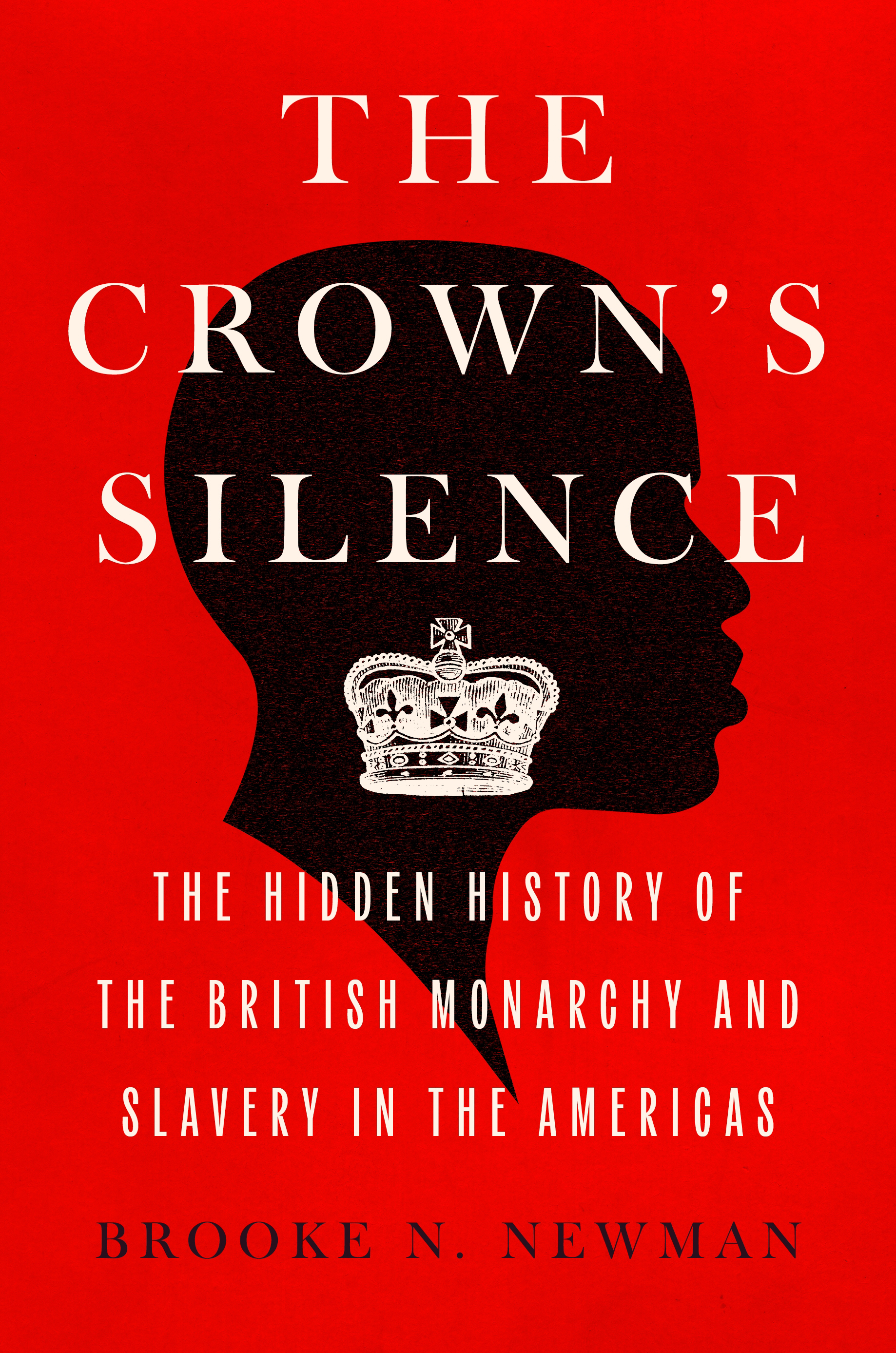
“The Crown’s Silence: The Hidden History of the British Monarchy and Slavery” by Brooke N. Newman
c.2026,
Mariner
$32.00
464 pages
There’s a reason for everything.
That doesn’t mean an excuse or a guess made of ignorance, but an explanation for what was, a kind of thought process that says if this happens, then that. A reason is a why, and in the new book, “The Crown’s Silence: The Hidden History of the British Monarchy and Slavery” by Brooke N. Newman, you’ll see why the story of Black America didn’t start in 1619.
In late November 2021, the Caribbean nation of Barbados held a celebration to mark the fifty-fifth anniversary of the day it removed Queen Elizabeth II as head of state and gained its political independence. The Queen wasn’t there, but Prince Charles was in attendance.
The Queen, in fact, didn’t even acknowledge the event.
Her silence resonated backward more than 450 years.
On July 24, 1564, Diego Guzman de Silva, a representative of King Philip II of Spain, was granted an audience with Queen Elizabeth I. He was there to petition the throne for reassurance that Captain John Hawkins, a merchant who’d been kidnapping Africans from Portuguese ships and selling them to Spanish colonists in the Caribbean, would not financially harm the Spanish kingdom. Elizabeth I promised de Silva that Hawkins was harmless, but, says Newman, she knew what Hawkins was doing and encouraged it by purposefully loaning him one of her largest warships. The reason: Elizabeth I’s coffers were lacking, and Hawkins brought gold back to England.

Gold was always the main thing, until the English were introduced to tobacco.
Tobacco, says Newman, was financially beneficial for newly arrived British colonists in what is now Virginia, but it takes a lot of work to grow and harvest the crop. African slaves did the work, as did the many indentured slaves in the New World – but by 1633, when contracts for the latter ended, workers were needed for those tobacco crops. More African slaves were brought up from the Caribbean to supplement the labor pool, until there were more
African slaves in North America than there were Spanish and English colonists…
With all the talk – and a recently updated version – of the “1619” story available, it’s easy to forget that enslavement of Africans didn’t just suddenly happen. “The Crown’s Silence” offers readers a wider, deeper look that lends even more understanding to the overall history.
And that should be your warning: there’s not one shred of fluff to this tale. Author Brooke N. Newman takes you into heavy-duty British history in a book that flirts strongly with academia. That may make it daunting, but it is not necessarily so; the story is complicated, but once you’re aware, it’s pretty easy to follow the timeline Newman lays out. Readers who think that America split from the U.K., centuries ago, in fact, will see that the ties lingered.
So does the righteous resentment, as it turns out.
While this is an excellent volume for any Black history collection, it’s not a breezy read by any means. Take your time, therefore, when reading “The Crown’s Silence.” Follow along carefully, and it’s a reasonably good book.