Bahamas
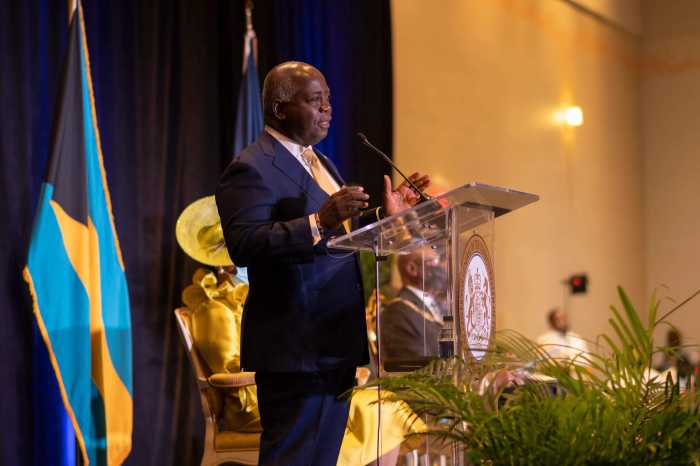
Bahamas Prime Minister Phillip Davis said that the period when the global economy appeared to run on autopilot, characterized by low interest rates and easy access to borrowing, is now in the past and no longer applicable.
“Inflation sat quietly in the background. Capital flowed across borders as if nothing could stop it. If you were lucky enough to be plugged into those flows, life could feel comfortable. If you were not, there was at least a feeling that the tide might eventually lift your boat too,” Davis said at the opening of the Invest Fest Bahamas conference.
The event was organized by The Bahamas International Securities Exchange (BISX) and brought together several regional and international leaders, investors, and innovators to shape the future of wealth in The Bahamas and the Caribbean.
Davis said that with the changing global environment, “interest rates have teeth again,” adding, “Climate events can wipe out assets in a single night. Technology is racing ahead of our habits. Geopolitics has returned in a very raw form, with trade, sanctions, and payment systems used as tools of power. For a small island nation like ours, this new reality can feel unforgiving. We are exposed to storms, to swings in tourism, to movements in oil prices, to rules and standards we did not write.”
He said the country cannot pretend that none of this is happening, warning, however, “We also must not talk ourselves into helplessness.”
“We do not control the global weather, but we control how strong our foundations are.
“We do not control every movement of international capital, but we control what it finds when it comes here. We do not control the pace of technology, but we control how ready our people are to use it. That is where capital markets come in,” he said.
“It is where a nurse’s pension meets a company’s expansion plan. Where a young founder with a promising concept meets a crowd of small investors willing to take a chance. Where a government that wants to build airports and energy plants meets citizens and institutions who want a safe place to put their money.”
Barbados
The Central Bank of Barbados (CBB) recently said that the island’s overall economic outlook for 2026 remains favorable.
“Continued momentum in tourism, construction, and business services, supported by sustained public and private investment, underpins this outlook. Meanwhile, continued disciplined fiscal management, low and stable inflation, and robust external buffers provide resilience against external shocks,” it stated.
But the CBB, in its review of the Barbados Economy from January to December last year, said the challenge now is execution.
“Sustained public and private-sector collaboration, continued productivity gains, and timely implementation of reforms under BERT 2026 (Barbados Economic Recovery and Transformation) programme. will be critical to converting stability into higher growth, stronger resilience, and lasting improvements in living standards,” it stated.
The Central Bank said stable economic growth and low inflation prevailed in 2025, even as global trade tensions increased. Tourism, business and other services, construction, and agriculture supported real gross domestic product (GDP) growth of 2.7%.
The unemployment rate ended the third quarter at 6.6%, while jobless claims increased during 2025. Lower international oil and freight costs eased inflationary pressures, and the 12-month moving average inflation rate slowed to 0.7% by November 2025.
Guyana
Guyana says real economic growth is expected to remain strong with the oil and gas sector continuing to be the main driver of overall growth, supported by sustained dynamism in the broader non-oil economy.
Minister of Finance Dr. Ashni Singh said that this year, overall growth is projected at 16.2%, with growth in the non-oil economy at 10.8%.
Delivering the Guy$1.5 trillion (US$6 billion) budget to Parliament, Singh said that the agriculture, forestry, and fishing sector is projected to grow by 7.6% this year, with expansion expected across all sub-sectors.
He said the sugar sub-sector is projected to expand by 67.9%, while the rice sector is expected to grow by 1.8%. The other crops sub-sector is projected to grow by 9.8%.
Singh continued, saying that the livestock sub-sector is projected to expand by 2.6% and that the fishing sub-sector is also projected to expand, with a growth target of 2% for 2026.
He said the forestry sub-sector is also projected to grow by 7.6% this year, and the mining and quarrying sector by 17.6%.
“The oil and gas sector is projected to expand further by 17.9% this year. The four producing FPSOs in the Stabroek Block are projected to produce almost 307 million barrels of crude oil at a rate of approximately 840,000 bpd.”
Singh said the gold and bauxite mining sub-sectors are expected to expand by 5.4% and 19.3%, respectively, in 2026.
The minister told Parliament that manufacturing and construction are also expected to show growth, and “this year, we expect to see continued growth in key service industries such as financial and insurance activities, wholesale and retail trade and repairs, transport and storage, professional, scientific and technical services, and administrative and support services. These industries are projected to grow by 11%, 8%, 5.3%, 23.2%, and 6.9%, respectively,” he added.
He said that this year, the overall balance of payments is expected to record a surplus of US$151.3 million, mainly due to a projected reduction in the capital account deficit.
Singh said that the current account is expected to record a surplus of US$1.7 billion this year, with a projected merchandise trade balance of US$8.8 billion.
Haiti
Haiti’s presidential council stepped down after almost two years of intense rule alongside a U.S.-backed prime minister, who is expected to remain in power as the country prepares for the first general elections in a decade.
Days before the council was dissolved, the U.S. deployed a warship and two U.S. Coast Guard boats to waters near Haiti’s capital, where gangs control 90% of Port-au-Prince.
“The naval presence appears to provide the latest proof of Washington’s willingness to use the threat of force to shape politics in the Western Hemisphere,” said Diego Da Rin, an analyst with the International Crisis Group.
In late January, two of the council’s most influential members announced that a majority had voted to oust Prime Minister Alix Didier Fils-Aimé, defying calls from the U.S. government to uphold the country’s fragile political stability.
The council’s plan to oust Fils-Aimé appeared to have failed as it stepped down in an official ceremony last Saturday.
“We need to put our personal interests to the side and continue progress for security,” said the council’s outgoing president, Laurent Saint-Cyr, who rejected a push to dismiss the prime minister.
Fils-Aimé spoke briefly, saying he would address the nation later in the day.
“The presidential council has done its work by paving the way for a governance mindful of security and electoral issues,” he said.
Da Rin said negotiations are ongoing to decide what, if anything, would replace the council as a new multinational security mission prepares to transform a U.N.-backed mission led by Kenyan police that was understaffed and underfunded.
Trinidad and Tobago
Minister of Energy Dr. Roodal Moonilal, says Trinidad and Tobago continues to be viewed as a respected global energy player, with international oil and gas companies now describing the country as the “gold standard” for doing business efficiently in the sector.
Speaking at a post-Cabinet news conference, Moonilal highlighted his trip to India for India’s Energy Week and Conference from Jan. 27 to 30.
He also confirmed T&T’s participation in the Guyana Energy Conference, scheduled for Feb. 17-20.
“I can confirm now that the Government of T&T will participate in the Guyana Energy Conference. We expect to meet and discuss several issues of related interest to both governments and peoples.”
He said he participated in a ministerial panel discussion titled “Shifting the exploration and production capital equation: attracting investment and driving global partnerships”, which focused on new partnership models in upstream oil and gas.
“I was extremely honoured to be on a panel moderated by Dr Amrita Sen of Energy Aspects. The panel included the Honourable Julie Moyo, Minister of Energy and Power Development of the Republic of Zimbabwe, and the Honourable Salome Makamba, Deputy Minister of Energy of the United Republic of Tanzania.”
According to the Energy Minister, discussions centred on rising global energy demand over the next 25 years and T&T’s role in meeting that demand.
Compiled by Devika Ragoonanan