Antigua and Barbuda
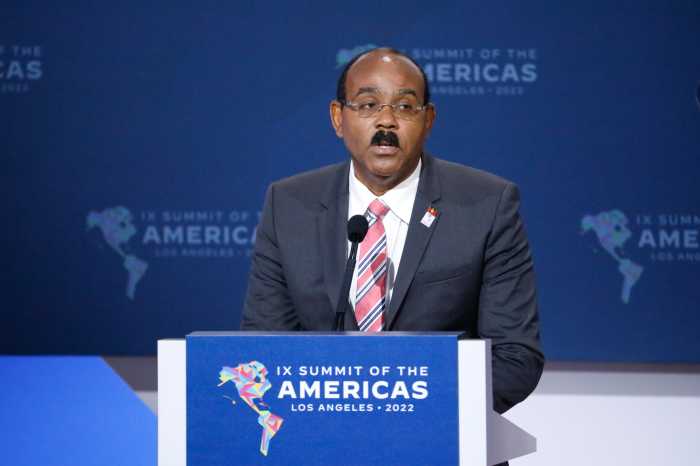
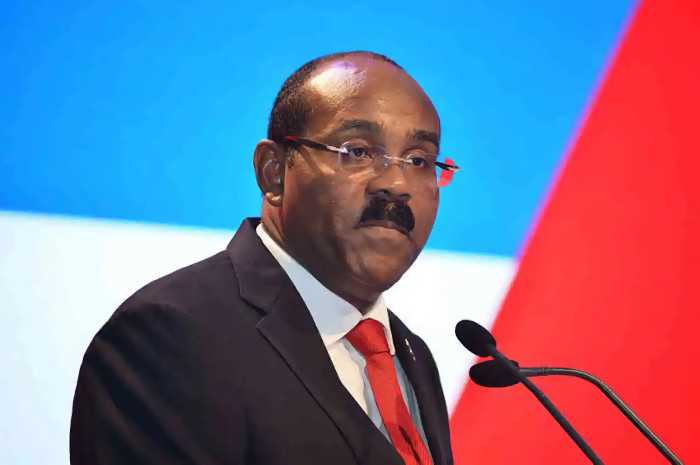
Antigua and Barbuda’s Prime Minister, Gaston Browne, said he is optimistic that Trinidad and Tobago will pay the remaining US$60 million owed to policyholders following the collapse of Colonial Life Insurance Company (CLICO) and British American Insurance Company (BAICO), which caused major financial losses across the Organisation of Eastern Caribbean States (OECS).
A previous government led by Kamla Persad-Bissessar had agreed to provide US$100 million in compensation, and US$40 million was already paid, leaving US$60 million outstanding.
After meeting Persad-Bissessar during the Caribbean Community (CARICOM) summit, Browne said the talks were positive and acknowledged Trinidad and Tobago’s economic challenges.
He stated: “I would say that the discussions were very cordial and we understand fully the fiscal difficulties that Trinidad and Tobago is faced with at this time.
“The discussion centred around paying the balance of US$60 million over an extended period, a period that will not create any significant cash flow problems to the Government of Trinidad and Tobago,” Browne told reporters.
He added: “I sense that she is willing to honour that commitment that she made several years ago.
“In fact, she honoured it partially by paying the first US$40 million. So I remain hopeful that a final determination will be made in the upcoming weeks. But she did not resist honouring the remaining US$60 million, other than we had to take into consideration the fiscal problems and certain economic problems that Trinidad has at this time,” Browne added.
Barbados
The government of Barbados has presented its 2026–2027 national budget in Parliament ahead of debate on the Appropriation Bill 2026.
For the 2025–2026 financial year, revised figures show total revenue of Bds$3.856 billion and total expenditure of Bds$3.939 billion (excluding amortisation).
This results in a revised fiscal deficit of Bds$83.8 million… equivalent to 0.5% of gross domestic product (GDP), with GDP estimated at Bds$16.243 billion. Despite the deficit, the primary balance is projected to record a surplus of Bds$658.4 million, or 4.1% of GDP.
For 2026–2027, the government expects a major increase in revenue. On a cash basis, revenue is projected at Bds$5.179 billion, representing an increase of Bds$1.323 billion, or 34.3%, over the revised 2025–2026 level.
Total expenditure is estimated at Bds$6.139 billion on the accrual basis, including amortisation. On a cash basis and exclusive of amortisation, total spending is projected at Bds$5.076 billion, with Bds$4.186 billion for current expenditure and Bds$889.8 million for capital spending.
Government spending increases include goods and services rising from Bds$590.5 million to Bds$966.7 million, while current transfers are projected to increase by Bds$368.4 million, or 32%, to Bds$1.520 billion.
Debt servicing costs are expected to reach Bds$1.496 billion, and the primary balance for 2026–2027 is projected to record a surplus of Bds$817.5 million, equivalent to 4.8% of GDP.
These estimates will guide parliamentary debate as legislators consider the Appropriation Bill for the upcoming fiscal year.
Caricom
While addressing leaders at the 50th Regular Meeting of the Conference of Heads of Government in Saint Kitts and Nevis, Caribbean Community Secretary-General Carla Barnett said 2025 was one of the most difficult years for the Caribbean, citing climate disasters and geopolitical tensions.
Barnett said the region faced several challenges that threatened development progress, including Hurricane Melissa, which significantly affected several countries, particularly Jamaica.
Despite the damage, she emphasized the region’s resilience, stating: “But in its aftermath, the region demonstrated its resilience and strength.”
“…Our institutions such as the Caribbean Disaster Emergency Management Agency and the Caribbean -Public Health Agency responded immediately with hands and with heart to safeguard livelihoods and address humanitarian needs. Expert teams from member states mobilised technical personnel for rapid assessment, logistic coordination and the movement of relief supplies.”
“We acknowledge our partners in the region and beyond whose overwhelming response helped our community to recover and build resilience as we experience, with increasing frequency and severity, extreme weather events,” she said
She further highlighted the region’s “solid record of democratic governance,” noting that seven member states held general elections since July 2025.
Barnett also pointed to regional unity, including joint advocacy on Haiti and the expansion of free movement within the Caribbean Single Market and Economy (CSME) involving Barbados, Belize, Dominica, and Saint Vincent and the Grenadines.
She concluded by urging unity among member states, stating: “We must continue to act together where our interests align, which is sometimes far more often than it seems to appear.”
Guyana
The World Bank says Guyana is expected to lead economic growth in the Caribbean over the next two years, remaining the region’s fastest-growing economy.
According to the Global Economic Prospects Report January 2026, the Caribbean economy is projected to grow by 5.2% in 2026 and 6.6% in 2027, largely driven by Guyana’s expanding oil sector.
Guyana’s economy is forecast to grow by 19.6% in 2026 and 21.9% in 2027.
Without Guyana, regional growth would be lower, with the Caribbean expected to grow about 2.9% in 2026 and 3.7% in 2027, supported mainly by tourism and related services.
However, the report warns that risks remain. It notes that “a key downside risk is an escalation of trade barriers,” adding that higher tariffs or restrictive outcomes from the United States–Mexico–Canada Agreement review in 2026 could slow regional economic activity.
The World Bank also cautioned that “higher-than-anticipated trade barriers and persistently heightened global uncertainty could weigh on external demand,” reducing investment and exports.
Other concerns include high debt levels, current account deficits, and climate-related disasters, which could worsen economic vulnerabilities.
On the positive side, the report says advances in artificial intelligence could boost growth through increased digital investment and productivity improvements.
Haiti
Leaders of the Caribbean Community (CARICOM) concluded their four-day summit in Saint Kitts and Nevis by reaffirming support for Haiti as it faces an ongoing political and humanitarian crisis.
CARICOM chairman Dr. Terrance Drew said the CARICOM-appointed Eminent Persons Group (EPG) — chaired by former St Lucia Prime Minister Kenny Anthony — submitted a report on Haiti’s political, security, and humanitarian situation.
Drew said the group expressed “deep appreciation” to Kenya for its “unhesitating willingness to take on leadership of the Multinational Security Support mission,” which has transitioned into the Gang Suppression Force authorised by the United Nations Security Council.
He noted that CARICOM leaders “reiterated Caricom’s firm commitment to the restoration of peace and stability in Haiti” and supported a framework proposed by Haiti’s prime minister aimed at improving security and holding elections.
The summit also reviewed progress on the Caribbean Single Market and Economy (CSME), which promotes free movement of goods, labour, skills, and services across the region.
Leaders approved recommendations to expand free movement categories to include aviation professionals such as aircraft maintenance engineers, professional pilots, air traffic controllers, and flight operations officers.