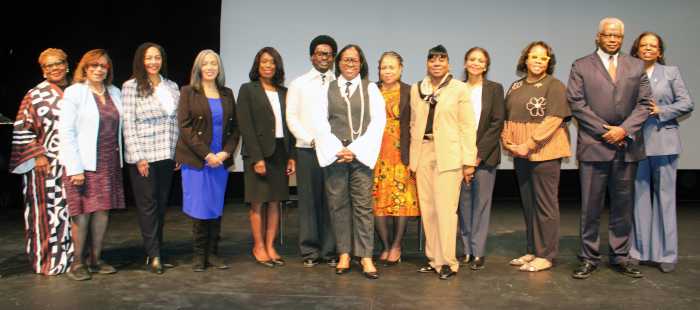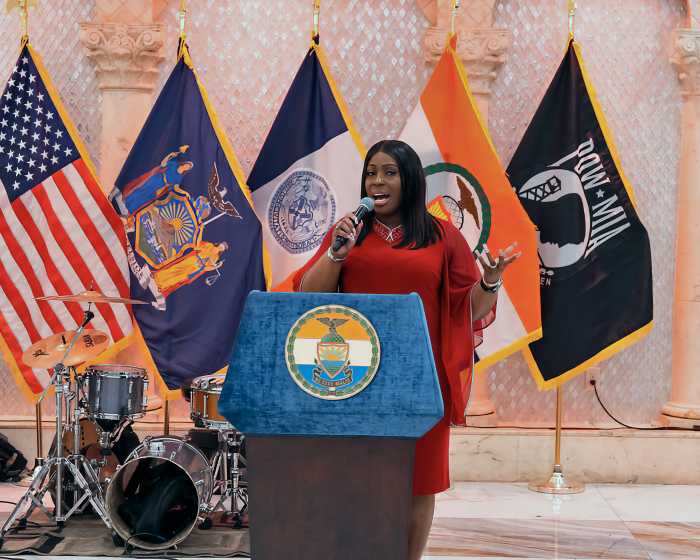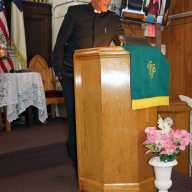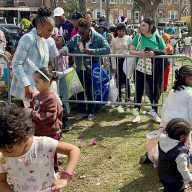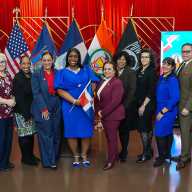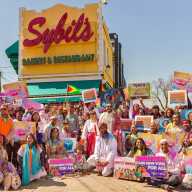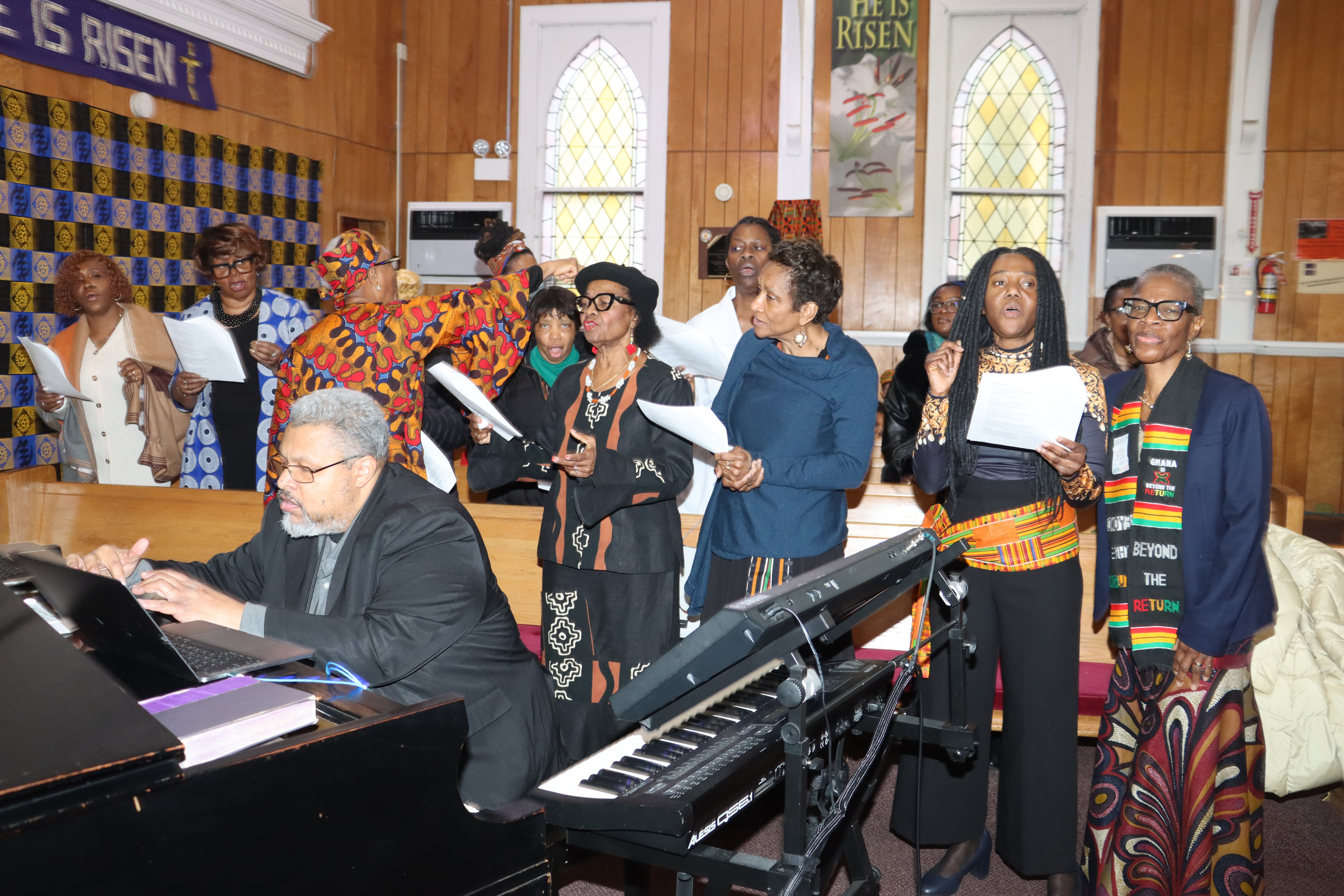
With drumming, lofty singing, poetry reading, dramatization, and preaching, among other things, the 135-year-old Fenimore Street United Methodist Church (FSUMC) in Brooklyn on Sunday, Feb. 22, celebrated in grand style Black History Month during its annual Heritage Sunday Worship Service.
Jamaican-born Sis. Dianne Brown, chair of FSUMC Higher Education Committee, led the Sunday School children’s procession into the sanctuary, with drumming by Trinidadian Nigel Telesford, “expressing their gratitude to our ancestors for their unwavering faith to keep the tradition of drum-beats alive, even in modern times,”
Sis. Joycelyn King, the church’s Antiguan-born lay leader and deputy Sunday School superintendent, told Caribbean Life afterwards.
Brown also dramatized Marilyn Lott’s poem “Black History Month” to Telesford’s drumming.
Brown also dramatized Marilyn Lott’s poem “Black History Month” to Telesford’s drumming.
Brown ended with President Barack Obama’s “Change”: “Change will not come if we wait for some other person or some other time. We are the ones we have been waiting for. We are the change that we seek.”
In the Sunday School presentation, twins Noelani and Nicholas Charles, 10, composed their own Black History Moment, with assistance from their 5th Grade Teacher, Janet Zysberg, at P.S. 235 Janice Marie Knight, in East Flatbush, Brooklyn.
“Black History is not just something from long ago; it is a powerful story that continues to grow every single day,” they said. “Throughout history, brave men and women stood up for fairness and equality, even when it was difficult and even dangerous.
“Leaders like Dr. Martin Luther King, Jr., Rosa Parks, Harriet Tubman, and so many others showed us what courage looks like,” Charles added. “They taught us that one person’s voice can make a difference. Because of their strength and determination, our nation moved closer to the dream of freedom and equality for all.”
But the twins said Black history is not only about the past; “it is also about scientists, inventors, artists, athletes, teachers, and leaders who continue to inspire us today.
But the twins said Black history is not only about the past; “it is also about scientists, inventors, artists, athletes, teachers, and leaders who continue to inspire us today.

“From inventors who created life-changing tools, to musicians who shaped the sound of generations, to leaders who continue to fight for justice, Black excellence is everywhere,” Charles said. “As children, we may feel small sometimes, but history shows us that even young people can create change.
“We can choose kindness,” they added. “We can include others. We can speak up when something is unfair. We can work hard to achieve our dreams.
“Today’s program is a celebration of resilience, brilliance, creativity, and hope,” Charles continued, urging everyone to “listen, learn, and reflect on how each of us can help build a future that is fair, respectful, and full of opportunity for everyone.”
Chase King, 6, Sis. King’s grandson recited the poem “Dreams” by Langston Hughes, and Daen Belany, also 6, shared his research on Benjamin Bannerker.
According to the Phoenix, AZ-based Civics for Life, Banneker was born free in 1731 on a small farm near the Patapsco River in Maryland, “far from the centers of political power shaping the young nation.
According to the Phoenix, AZ-based Civics for Life, Banneker was born free in 1731 on a small farm near the Patapsco River in Maryland, “far from the centers of political power shaping the young nation.
“He never held office, never voted, and never addressed a legislature in person,” Civics for Life said. “Yet, Banneker became one of the most widely known Black intellectual figures of the early republic, using mathematics, astronomy, and the written word to assert his place in American civic life.
“At a time when many Americans questioned whether people of African descent were capable of reason or learning, Banneker responded with evidence,” it added. “His work — carefully calculated, publicly shared, and unmistakably rigorous—stood as a quiet but powerful challenge to the racial assumptions embedded in the political culture of the founding era.”
An initiative of the Sandra Day O’Connor Institute, Civics for Life is an online resource center for multigenerational civics education, civil discourse, and civic engagement.
Angelica Nedd, 13, another FSUMC Sunday School member, also read the poem, “I Know Why The Caged Bird Sings,” by Maya Angelou.
It says, in part: “A free bird leaps on the back of the wind/and floats downstream till the current ends/and dips his wing in the orange sun rays and dares to claim the sky/The caged bird sings with a fearful trill/of things unknown but longed for still/and his tune is heard on the distant hill/for the caged bird sings of freedom.”
It says, in part: “A free bird leaps on the back of the wind/and floats downstream till the current ends/and dips his wing in the orange sun rays and dares to claim the sky/The caged bird sings with a fearful trill/of things unknown but longed for still/and his tune is heard on the distant hill/for the caged bird sings of freedom.”
Jamaican Irlene Braithwaite led the congregation in Praise and Worship with, among others, “Wade in the Water,” “Gonna Lay Down My Burdens,” and “Swing Low.”
The Combined Choir then heightened the tempo with “Ole Time Religion.”
The Combined Choir then heightened the tempo with “Ole Time Religion.”
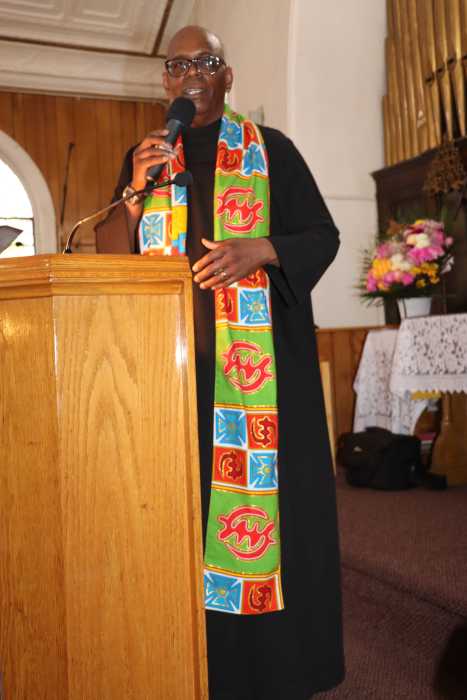
In his sermon, “What Does God Say?” based on 2 Matt. 4: 1-11, the church’s pastor, the Rev. Roger Jackson, preached: “Like it was with Jesus, when He was at His weakest and most helpless state, our temptations manifest themselves through physical needs and desires; possessions and power; and pride.
“And like it was in the case with Jesus, we are tested during those times, when we are under physical or emotional stress, because those are the times when we are most vulnerable,” he added. “But thanks be to God that Jesus knows first-hand what we have to deal with and what we are going through.
“He is intimately familiar with everything that is common to us because He experienced it all when He walked this earth,” Pastor Jackson continued. “And thank God that we can turn to Him for help, and He’s willing to help us in our struggle to resist the bait that is beckoning us to give into temptation to do those things which run contrary to what we know about the power and presence of God the Father in and over our lives.”
Rev. Jackson said that “since God has affirmed us as adopted children, heirs in Jesus Christ, He will send angels to meet our every need also.
“God’s divine plan for us is that, when faced with the types of life decisions that are pertaining to our witness as disciples of Jesus Christ, we must not lean to our own understanding but ask the question of ourselves, ‘What does God say?’” He added.
“God’s divine plan for us is that, when faced with the types of life decisions that are pertaining to our witness as disciples of Jesus Christ, we must not lean to our own understanding but ask the question of ourselves, ‘What does God say?’” He added.
By living by the word of God, Pastor Jackson said, “We are trusting that God knows best, and we will be able to affirm along with the Psalmist, ‘Your word is a lamp to my feet and a light for my path.’