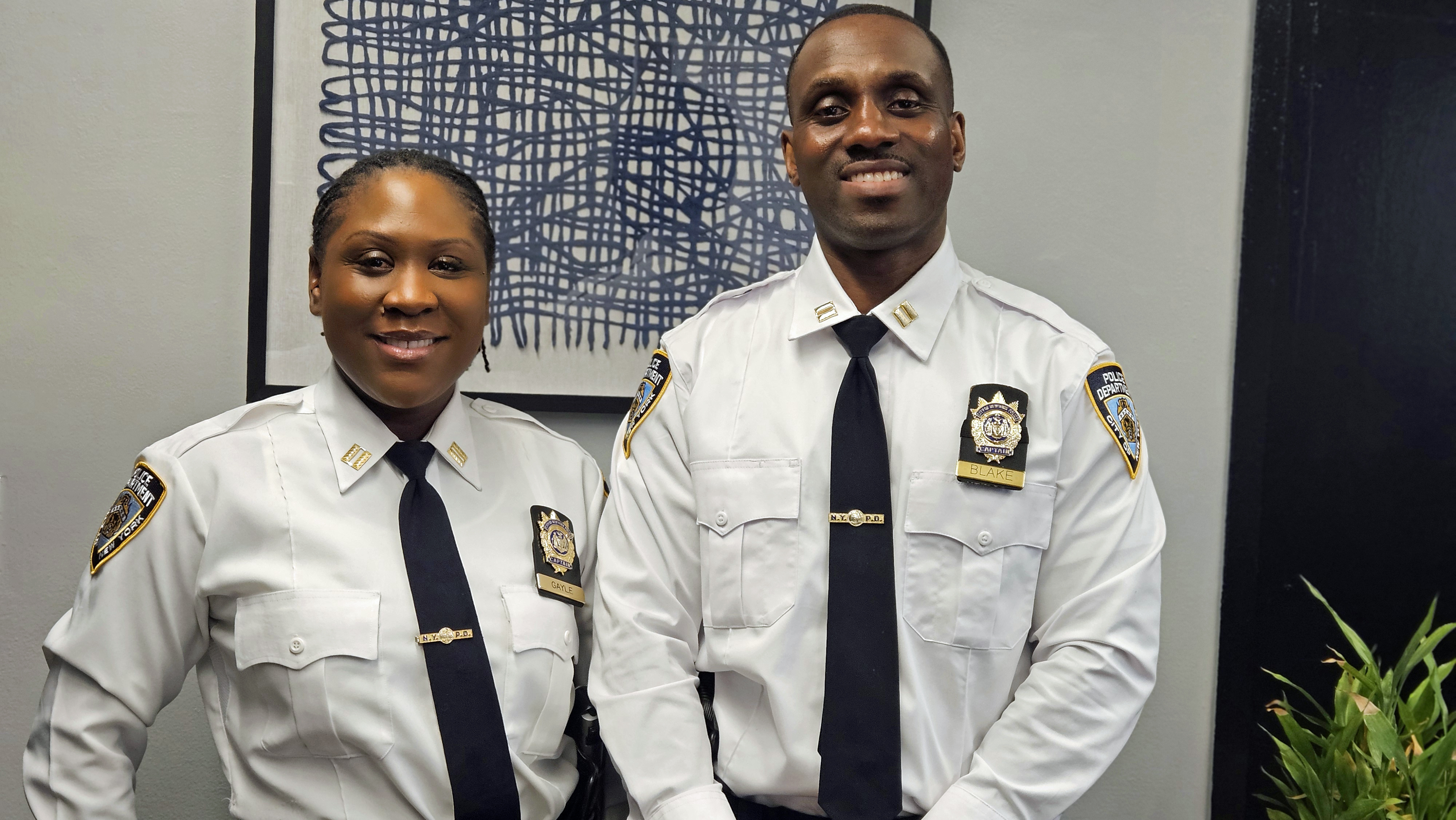
In the heart of Upper Manhattan, two Jamaican-born captains are leading one of New York City’s busiest police commands, carrying with them the lessons of the Caribbean and the weight of representation during Black History Month.
Captain Veniece Gayle, commanding officer of the 24 Precinct, and Captain Paul Blake, the precinct’s executive officer, both immigrated from Jamaica as children. Today, they hold leadership positions within the New York City Police Department (NYPD), the largest police department in the United States. Their presence at the helm of the precinct is more than symbolic; it reflects the evolving face of leadership in law enforcement and the enduring influence of Caribbean heritage in shaping it.
For Captain Gayle, who arrived in New York at 13 and grew up in the Bronx, Jamaican culture laid the foundation for her career.
“Being a Jamaican immigrant, our heritage is deeply rooted in strength, independence and cultural pride,” she said. “It set the foundation for me to reach for the stars and strive for excellence.”
As a Black Caribbean woman in uniform, she understands the weight of visibility, particularly during Black History Month.
“Women leadership in law enforcement is not only possible, but it’s powerful,” she said. “Me sitting in this seat shows young immigrant women and young Black women that their background is their strength, not their limitation.”
Captain Blake, who came to the United States at age 7, credits his single mother’s work ethic for shaping his path.
“I just wanted to make her proud,” he said. “I saw how hard my mother worked, and I wanted to work hard as well.”
Growing up, he said, he rarely saw Black officers in leadership roles. That absence motivated him.
“I thought, let me become a Black police officer,” he said. “I can relate to the people. I’ve worked my entire career in predominantly Black communities. It’s about helping and solving problems, not just enforcement.”
Both captains describe their rise through the ranks as demanding but purposeful. Long hours studying for promotional exams meant time away from family. Captain Gayle balanced overnight shifts while raising two children, recalling how she joined the Police Academy when her son was just five months old.
“When I struggled, my motivation was, ‘You have to run for him,’” she said.
Their defining moments underscore the human side of policing. Captain Gayle remembers a father in Harlem telling his young daughter, “She’s a woman like you. And she’s Black like you,” as the child looked up at her with admiration. Captain Blake recalls a woman he once arrested returning months later to thank him for speaking to her with dignity, a conversation she said changed her life.
During Black History Month, both captains say their service is about legacy. Captain Blake hopes to leave behind a culture of integrity.
“No matter what, just do the right thing,” he said.
Captain Gayle points to hard work and discipline, values deeply embedded in Caribbean households.
“With hard work and discipline, the sky’s the limit,” she said.
For New York’s Caribbean community, their leadership represents progress forged through immigration, sacrifice and resilience. In uniform, they embody both Black history and Caribbean pride, proof that heritage can guide public service and that representation at the highest levels can inspire the next generation.