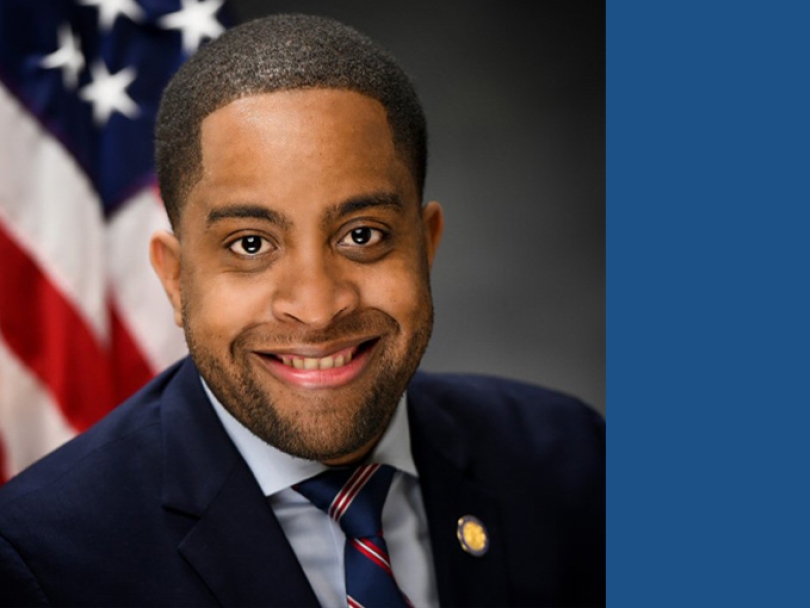
As the Trump administration pulls back from enforcing laws against corporate wrongdoing, Sen. Zellnor Myrie (D-Central Brooklyn) has introduced S.8594, the “RIPOFF Act,” overhauling New York State’s laws against white-collar crime and fraud that costs New Yorkers hundreds of millions of dollars each year.
“Corporate criminals are using increasingly sophisticated tools to go after innocent New Yorkers and their hard-earned money, but our laws have been frozen in time for decades,” said Myrie, chair of the powerful Senate Codes Committee, who represents the 20th Senate District in Brooklyn. “The RIPOFF Act brings our laws and penalties for white collar fraud into the 21st century.
“In the financial capital of the world, the punishments for white collar scams and frauds must fit the severity of the crime,” added Myrie, whose grandmother hailed from Jamaica.
He said the “Restoring Integrity and Preventing Outright Fraud in Financial Systems (RIPOFF) Act” makes updates to sections of the Criminal Procedure, General Business, Labor, Legislative, Public Officers, State Finance and Tax laws by establishing and defining several new white collar criminal offenses including structuring, schemes to defraud and defrauding the government.
Myrie said the bill updates public bribery statutes by removing the requirement for an explicit “agreement or understanding” that an offered benefit will influence a public servant’s actions.
He said the RIPOFF Act also defines and penalizes criminal transactions related to virtual currency where fraud has increased dramatically and where victims have been left with little to no means of recovery.
Notably, Myrie said the RIPOFF Act establishes “corporate equity fines” for corporations doing business in New York with annual revenues exceeding $100 million.
Under this law, Myrie said a court could impose fines consisting of a percentage of a large corporation’s equity (stock shares) as a penalty for a white collar criminal offense.
He said these shares would be deposited into a state-managed victims’ compensation fund.
Myrie noted that New York’s existing penalties for white collar crimes were last amended in 1987.
Since then, he said artificial intelligence, cryptocurrency and other technologies have made scams and frauds against innocent New Yorkers easier to commit and more difficult to prosecute.
In 2013, Myrie noted that a task force of district attorneys issued “a clarion call to modernize state statutes, clearly define offenses, update fraud and bribery provisions and stiffen penalties; however, little action has been taken on the task force’s recommendations.
“Meanwhile, the Trump administration has made clear it intends to scale back enforcement of financial crimes, including by shuttering the Consumer Financial Protection Bureau (CFPB) and ordering the DOJ (Department of Justice) and FBI (Federal Bureau of Investigation) to prioritize immigration enforcement over white-collar crimes,” he said.
“Strengthening penalties for fraud and white-collar crime should be a bipartisan priority — it’s about protecting regular, hardworking New Yorkers and restoring trust in businesses and our government,” said Senator Liz Krueger (D-Manhattan). “I’m proud to support a bill that brings New York’s fraud statutes into the 21st century by including virtual currencies and increases penalties for large corporations so that bad actors will think twice before breaking the law.”
“Scammers are using increasingly sophisticated schemes and digital currencies to steal people’s life savings, often preying on the most vulnerable in our communities,” said Brooklyn District Attorney Eric Gonzalez. “This bill modernizes our laws and provides vital tools to help law enforcement get justice for those who have been victimized. I commend Senator Myrie for his leadership on this important legislation and encourage our leaders to make it a priority in the upcoming session.”
Manhattan District Attorney Alvin Bragg, Jr., said: “This bill would empower prosecutors to take on new kinds of financial crimes while ensuring penalties commensurate to the real harm they cause New Yorkers. I thank Senator Myrie for both his partnership and his leadership on this critical bill.”
“At a time when scams and complex financial schemes are on the rise, corporate criminals have evolved their methods to exploit hardworking New Yorkers out of millions of dollars, often through sophisticated digital and virtual-currency-related transactions,” said Staten Island District Attorney Michael E. McMahon. “Thankfully, the RIPOFF Act would equip law enforcement with the modern tools necessary to meet that challenge head on, ensuring that our neighbors and loved ones are protected from these brazen larcenists.
“We’ve spent plenty of energy updating our criminal laws to enhance penalties and deter violent crime,” concluded Myrie. “But crime in the suites can be just as damaging as crime in the streets. It’s past time New York updates our statutes against white collar offenses to modernize our laws and ensure penalties for breaking them are meaningful.
“While the federal government steps back, New York will step up to protect our markets and our consumers,” he added.