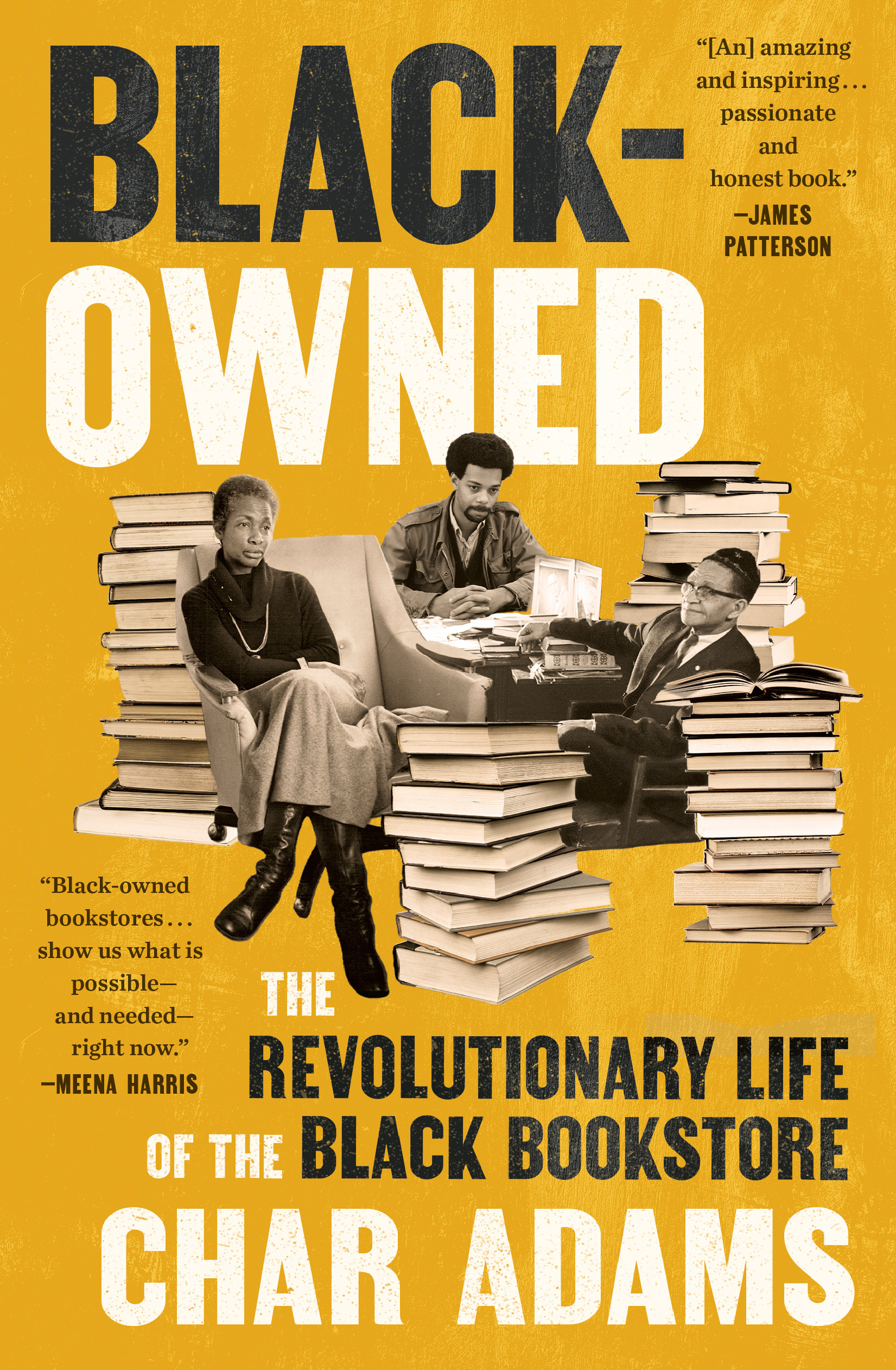
“Black-Owned: The Revolutionary Life of the Black Bookstore” by Char Adams
c.2025,
Tiny Rep Books
$32.00
291 pages
You’re not planning on being selfish.
But seriously, you’ve been waiting months for the release of your favorite author’s newest book, and it’s in stores NOW. You have your copy; you’ll be the first one to open it. Your easy chair is ready, and no bookmarks are needed. As in the new book “Black-Owned” by Char Adams, you knew just where to find it.
For many people, it’s a dream: owning a bookstore, discussing books all day, and putting good reads into people’s hands. These are the kinds of stories Char Adams says she likes telling, and she was surprised when she started researching for this book. The tales of Black bookstore owners are rarely told.
David Ruggles, for instance, was a Black abolitionist in New York, and he had quite a reputation for his ability to “inspire almost any crowd to action.” In 1834, he opened what would be America’s first Black bookstore, using it “as a home for both anti-slavery literature and his activism.”
A century later, Harlem’s Lewis Michaux became the first person to make a career with a bricks-and-mortar bookstore when he opened the National Memorial African Book Store in 1933. He was a man of determination, having gotten his start “selling periodicals… with a bullhorn outside his shop” every day.
During the Civil Rights Movement, Black-owned bookstores such as the Drum and Spear in Washington D.C., Vaughn’s Bookstore in Detroit, and Liberation Bookstore in Harlem hand-picked their stock to reflect the battle for Black rights – and sometimes, that meant violence visited their stores. The Hue-Man Experience in Denver became a home for Black authors to launch new books and nurture their careers; from the 1970s to the 1990s, Black publishers began partnering with America’s Black bookstores to further those careers, and mainstream publishers eventually followed suit.
Today, Black-owned bookstores likely have a digital footprint to reach readers. Digital, however, “will not be the end of Black-owned bookstores…” says Adams.
“As long as the fight for Black liberation exists, so will these shops.”
Before you start reading “Black-Owned,” be sure you have a pen and notebook close by. You’ll need them to write down all the bookstores you’ll want to visit, places you’ll regret missing, and places you’ll learn about inside this fascinating volume.
But that’s just a part of what you’ll find here. Author Char Adams also tells the long story of Black authors and publishers, and the struggles both have – and sometimes still face- to get their books into readers’ hands. It’s a surprising journey that seems intuitive now, but it wasn’t so in the not-so-distant past. Bookstores and authors had to learn, by necessity, how to work together, an offshoot of the activism found in 1960s-era bookstores that continues to this day. It’s a nice circle of time that readers will appreciate.
Absolutely, this is a book meant for anyone who has a sky-high TBR pile and who’s heading to the bookstore this week. Find “Black-Owned.” It’s just what you want when you need to read.