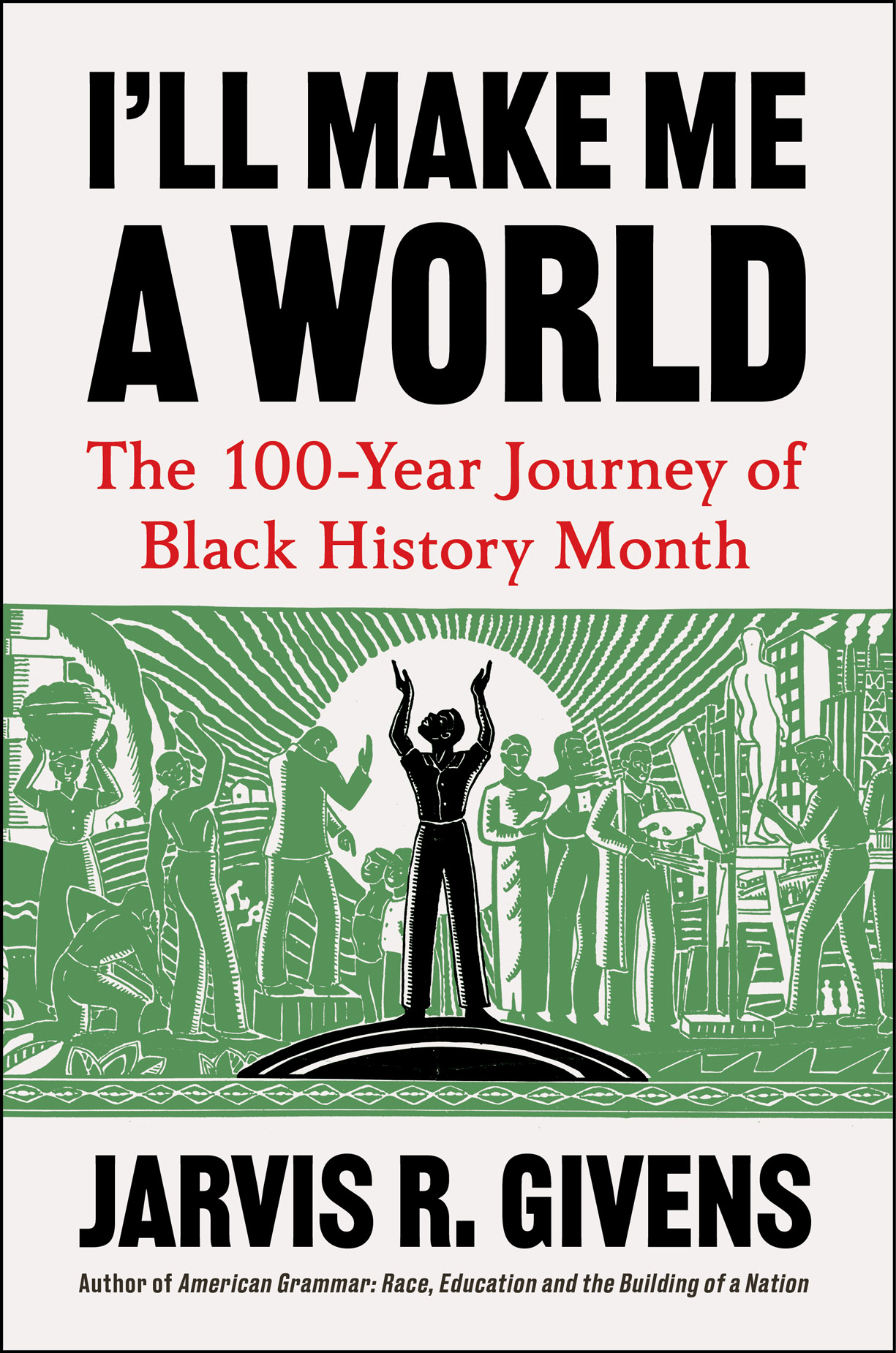
“I’ll Make Me a World: The 100-Year Journey of Black History Month” by Jarvis R. Givens
c.2026,
Harper
$24.99
256 pages
You gotta start somewhere.
First, you crawled, then you toddled, and then you ran, which is exactly how most things are. There’s a foundation from which to spring, a base from which to jump, and you need to figure out how to best proceed so you can succeed. You gotta start somewhere, and in the new book “I’ll Make Me a World” by Jarvis R. Givens, it started with racism.

James McCune Smith was just 14 years old the day New York passed its Emancipation Act. Smith had been born into slavery but was officially freed on July 4, 1827. He later wrote about the celebration. He never forgot it.
Neither did those who learned of their freedom in Texas on June 19, 1865, nor William Cooper Nell, who is credited with the first Crispus Attucks Day. And yet, these were early parts of the foundation of Black History Month.
In February 1926, public school teacher Carter G. Woodson, in conjunction with the Association for the Study of Negro Life and History in Washington, D.C., established the first Negro History Week. Givens says that it was an entirely political move, meant to call Americans. attention to black life and culture. Black newspapers picked up the story and spread it around the country to Black readers and Black churches. By 1935, the Negro History Week was celebrated widely in Black schools and communities.
In the fall of 1975, esteemed members of the renamed Association for the Study of Afro-American Life and History gathered in Atlanta to celebrate Woodson’s birthday and to change things up. With America’s bicentennial coming the following summer, and considering all that had happened since Negro History Week was founded, it seemed that a Black History Month was appropriate. The members asked the White House for a proclamation, but President Ford could only issue a customary “presidential message” because he lacked congressional support. Ford’s letter, says Givens, did not acknowledge historical suffering.
It was not until 1986 that President Ronald Reagan issued a proclamation for Black History Month…
Black History, says author Jarvis R. Givens, is much more than what has been written. So is “I’ll Make Me a World,” in that it’s considerably more than what its subtitle seems to offer.
That’s not necessarily a good thing.
Packed with a timeline that spans more than a century on both sides, Givens includes so much Black history that it becomes overwhelming at times. Readers are taken back to the 19th century quite often and, as such, it generally takes a while to wind back to the hundred-year window that you’re expecting. That might not be a bad feature, but strictly speaking, this book is an abundance of history, but not as much Black History Month history as it promises. More of the latter, slightly less of the former, would have made this book stellar.
As it is, though, it’s a worthwhile read, informative, and eye-opening, but just know what you’re getting. Do that, find “I’ll Make Me a World,” and get started.