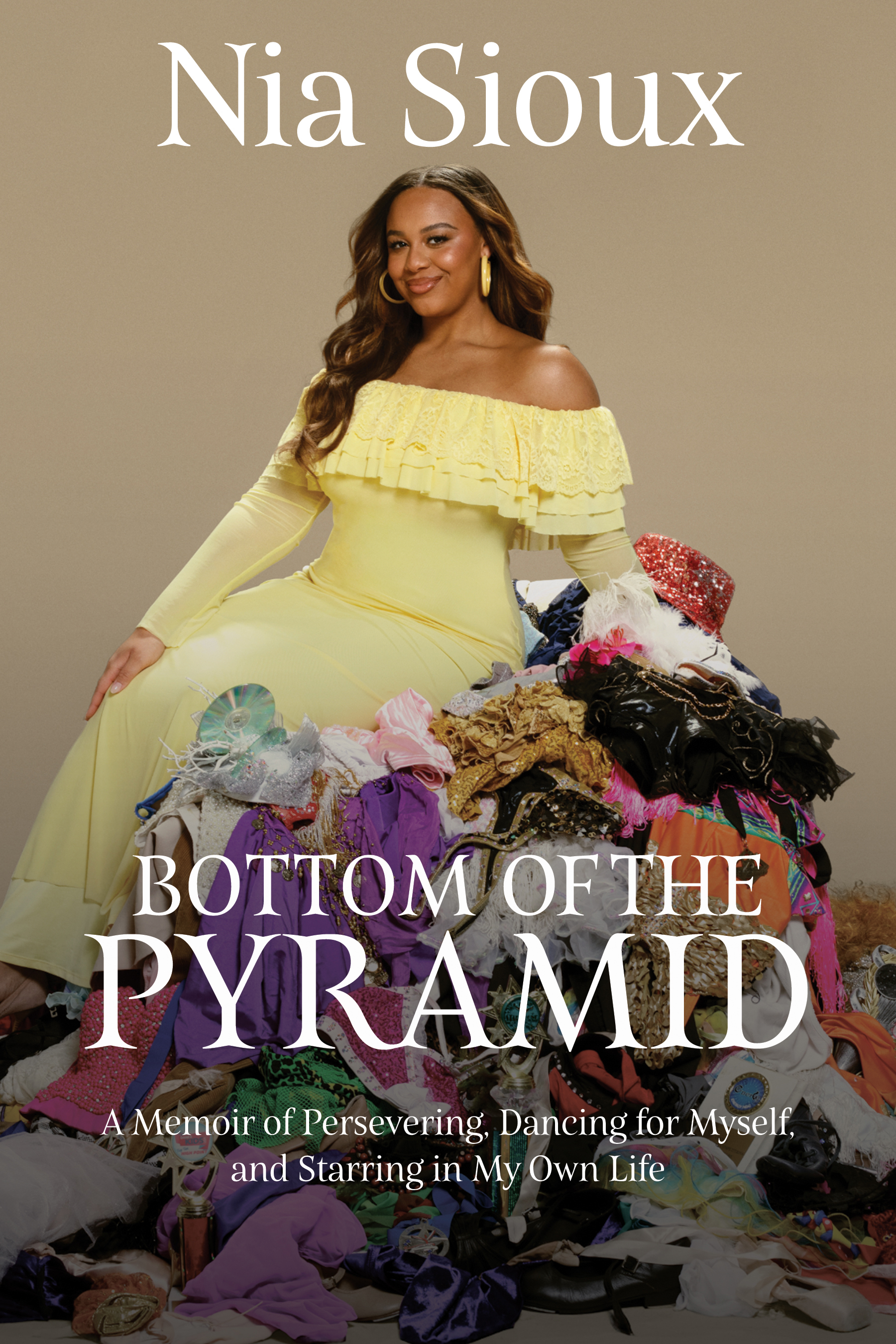
Bottom of the Pyramid: A Memoir of Persevering, Dancing for Myself, and Starring in My Own Life” by Nia Sioux
c.2025,
Harper Horizon
$29.99
256 pages
Every solid building has a strong foundation.
And when you’re hired for a new job, that’s where you start: at the bottom, in the back office, the least position, the lowest rung. You won’t stay there long if you can overcome the obstacles and seize all opportunities. It won’t be easy, but you can do it. As in the new memoir, “Bottom of the Pyramid” by Nia Sioux, when you’re in last place, there’s nowhere to go but up.
Nia Sioux always loved the stage.
Born into an upper-middle-class family, Sioux remembers how much she wanted to take dance classes when she was a preschooler, and how her parents were happy to support her interests. Fortunately, there was a dance studio just down the road from their Pittsburgh home, and so Sioux started classes at Dance Masters of Pennsylvania, later renamed Abby Lee Dance Company (ALDC). There, she worked hard and gradually moved up in the team’s lineup, garnering praise and solo dances.
Quickly, the solos made her mother very uncomfortable, she says. There seemed to be racial undertones to the costumes Sioux was made to wear, and the music didn’t seem appropriate for a little Black girl.
Mother and daughter discussed it, and Sioux’s eagerness overcame any doubt.
Later, when Lifetime Channel interviewed ALDC dancers for a TV show that was eventually called Dance Moms, Sioux was overjoyed to be chosen as one of the show’s performers. For a while, she was the only Black dancer in the team – and that became a problem.
Infamously, the show introduced a “pyramid” in which Abby ranked the dancers, and Sioux was almost always at the bottom. Drama was encouraged, criticism was swift, and there appeared to be a significant amount of favoritism within the dancers’ hierarchy. She endured the pain of it, but ultimately, she seized other opportunities and decided to quit Dance Moms.
“I’d gotten a glimpse of what my life could look like without the show,” she says, “and it was beautiful.”
Readers may not be surprised that Nia Sioux has written this memoir or that she describes both challenges and achievements.
The appeal of ‘Bottom of the Pyramid’ is in how engaging and satisfying her story is.
Going beyond the usual memoir and past the show’s curtain, Sioux shares her life story and its ups and downs, professionally and otherwise. There’s a lot of gratitude in that, plus strength and determination – but also some swiping, sniping, and resentment, all of which are like catnip to reality fans. Still, Sioux reminds readers that there were actual humans, young women, behind the lines and in second takes for the camera, and that the over-the-top theatrics could have a negatively impactful effect on their tender lives.
For a reality TV watcher or a fan of the show, past or present, that’s a good reminder to watch for authenticity inside the drama. If you have never missed an episode of the show or you want to follow the stars, “Bottom of the Pyramid” is a good place to start.