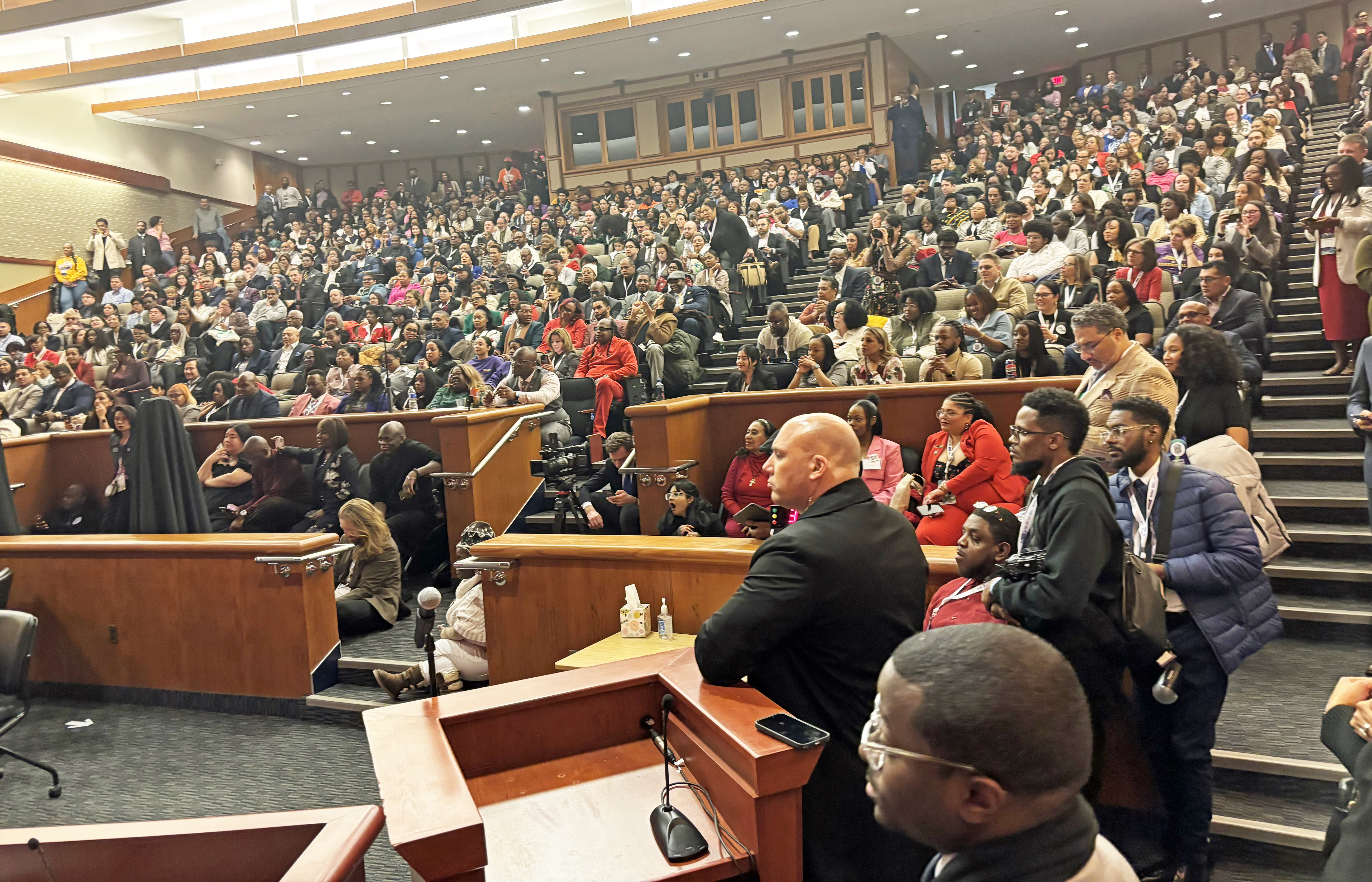
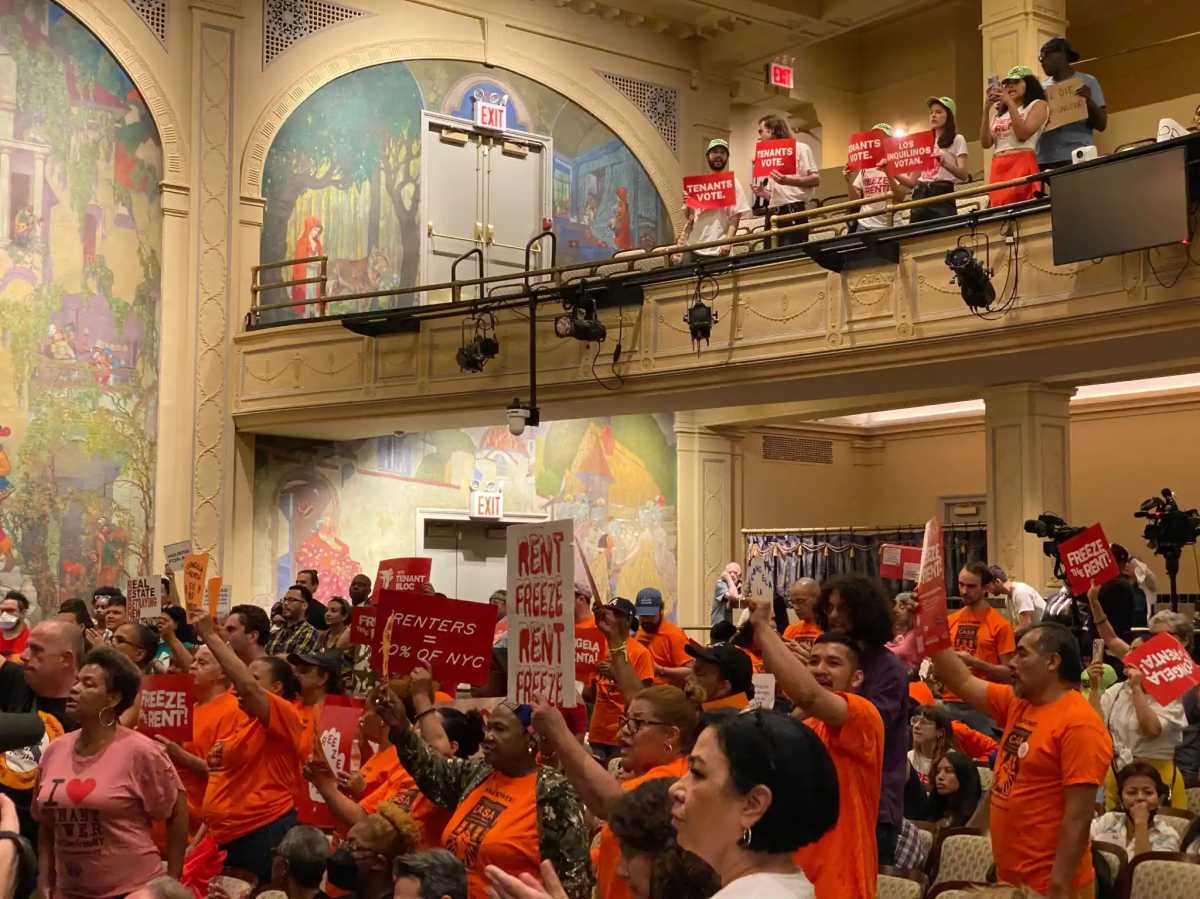
Attendees gather for the Mayor’s Forum in Hearing Room B of the Legislative Office Building.
Photo by Orlande Fleury
Founded in 1985 at a time when representation in state government remained limited for communities of color, the New York State Association of Black, Puerto Rican, Hispanic & Asian Legislators Inc. (NYSABPRHAL) has grown into one of the state’s leading nonprofit public policy advocacy organizations.
Established to amplify the collective voice of legislators of color and the communities they serve, the Association continues to champion equitable access to the state budget process, economic opportunity, education, housing, and social justice reforms across New York.
That founding mission framed the 55th Annual Legislative Conference, widely known as Caucus Weekend, held Feb. 13–15, 2026, at the New York State Capitol and surrounding legislative offices in Albany. The three-day convention brought together lawmakers, municipal leaders, advocates, business owners, students, faith leaders, and community stakeholders under this year’s theme: “Legacy Forward: Transforming Tomorrow Together.”
Association Chairwoman Assembly Member Latrice M. Walker, Esq. said the theme reflects both history and urgency. “Legacy Forward is about honoring the sacrifices of those who paved the way while building the policy frameworks that will protect and uplift our communities for generations to come,” Walker said. “We are not simply gathering; we are governing with purpose.”
“This year’s theme is “Legacy Forward: Transforming Tomorrow Together.” The mission is to engage New York State residents from marginalized communities in a dialogue about the issues and policies that directly impact their daily lives and communities,”,said Chairwoman, Latrice M. Walker.
Zohran Mamdani was among the New York State mayors in attendance during caucus weekend, participating in a comprehensive discussion that addressed multiple issues related to effective city leadership in “turbulent America,” a conversation centered on advancing the legacy.
The dialogue was moderated by New York State Attorney General Letitia James and hosted by Chair Assembly Member Latrice M. Walker and Vice-Chair Assemblymember Brian Cunningham on Saturday afternoon at the Legislative Office Building’s Hearing Room B.
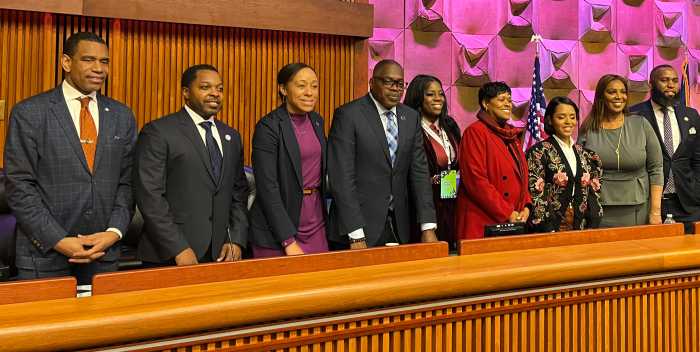
Mayors pose for a group photo following Saturday’s discussion, held Feb. 14 from 2–3:30 p.m. (from right): Malik D. Evans, Schenley Vital, Yadira Ramos-Herbert, Waylyn Hobbs Jr., Charlene Gayle, Executive Director of NYSABPRL, Inc., Sharon Owens, and Dorcey L. Applyrs with Attorney General Letitia James and Assembly Member Brian A. Cunningham. Photo by Orlande Fleury
The meeting brought the mayors together to encourage advocacy and strengthen connections among legislative leaders, policymakers, educators, community organizations, and constituents. The goal was to ensure that local voices help shape state-level decision-making.
Get the latest news and updates delivered to your inbox.
Thank you for subscribing!
The mayors who participated in the discussion included: Mayor Dorcey L. Applyrs, Albany, NY, Mayor Malik D. Evans, Rochester, NY, Mayor Waylyn Hobbs Jr., Hempstead, NY, Mayor Yadira Ramos-Herbert, New Rochelle, NY, Mayor Zohran Mamdani, New York City, NY, Mayor Sharon Owens, Syracuse, NY, qndMayor Schenley Vital, Spring Valley, NY.
“We know that there are so many more people who love to live in our city. There are so many who are being pushed out of our city, so we have to do many things at the same time. We have to build more housing than we have ever seen across the five boroughs. We also have to take steps to keep people in their homes. That’s why we talked about building 200,000 new, truly affordable, rent-stabilized homes over the next 10 years, freezing the rent for more than 2 million rent-stabilized tenants in our city, fighting to keep homeowners in their homes, and looking in every which way at how we can deliver stability to the people of New York City,” said Zohran Mamdani.
“We are here at Caucus Weekend. We also know the affordability crisis, the housing crisis, has disproportionately hit certain communities of New York City. When we think about Black New Yorkers, we have lost more than 200,000 Black New Yorkers within the last few decades, from 2010 to 2019. The housing population of Black children and teenagers has declined by 19%.
“If we do not take the steps necessary to grow and to keep our city and its people, then we will start to lose the place we love,” said Mamdani.
This highlights Mamdani’s plans to address New York City’s housing and affordability crisis, particularly the displacement of residents and the decline of Black New Yorkers.
In response to the moderator’s question about his goal in addressing economic disparity in New York City, Mamdani said,” Too often, we do not ask ourselves how difficult we have made it for small business owners to succeed.”
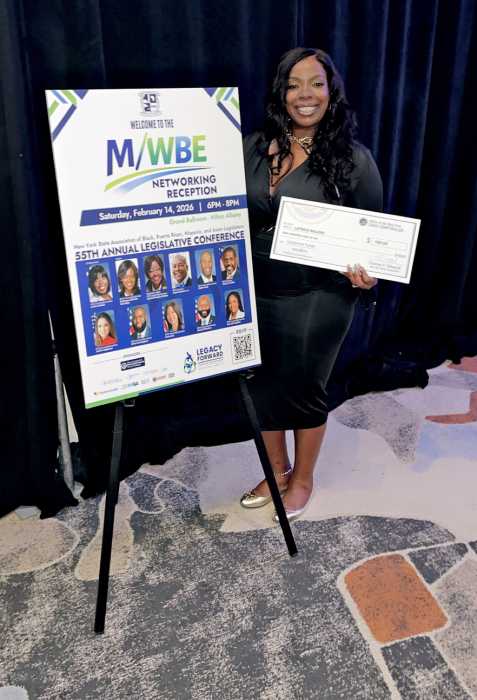
Latrice Walker, New York State Assembly Member and Chairwoman of the New York State Association of Black, Puerto Rican, Hispanic & Asian Legislators, Inc., shows support at the MWBE reception.Photo by Orlande Fleury
In an interview with Assembly Member Walker about effective partnership between state legislators and mayors especially when local governments are on the front lines of housing, she said, “Effective partnerships today must be strategic, transparent, and solutions-oriented. State legislators set broad policy frameworks and allocate resources, but mayors are implementing those policies in real time.”
“The relationship must be continuous, not transactional, and not limited to budget season. On housing, partnership means aligning state-level tenant protections, housing production incentives, and capital investments with local zoning realities and development pipelines. It means ensuring that state funding streams for affordable housing, supportive housing, and homelessness prevention are accessible and responsive to municipal needs,” Walker told Caribbean Life.
During the forum, Mayor Applyrs, the first Black woman Mayor of Albany, NY, highlighted several components of her economic development plan.
“Bringing Minority-and-Women-Owned Business Enterprises (MWBEs) into city resources is critical. We have a really strong summer youth employment program, and I think sometimes people underestimate the impact of our summer jobs for youth. With our youth here in Albany, I know the money that’s coming home sometimes also contributes to the household. We have expanded our summer youth employment program so that it goes beyond the summer,” she said.
“As we think through our economic development plan, I understand there are some individuals in our communities who sometimes don’t know where to start, even when it comes to writing a business plan. They are on the block, innovative, and know how to get things done. But they don’t have access, connections, or the information.
“What I am looking to do as part of our economic development plan is to ensure it reaches even those on the block who have so much to offer our city but who feel very marginalized right now. The plan includes basic information on how they can get involved in our economic development strategy,” said Applyrs.
Since taking office on Jan. 1, 2026, Mayor Applyrs has made it clear that her administration will focused on serving the people.
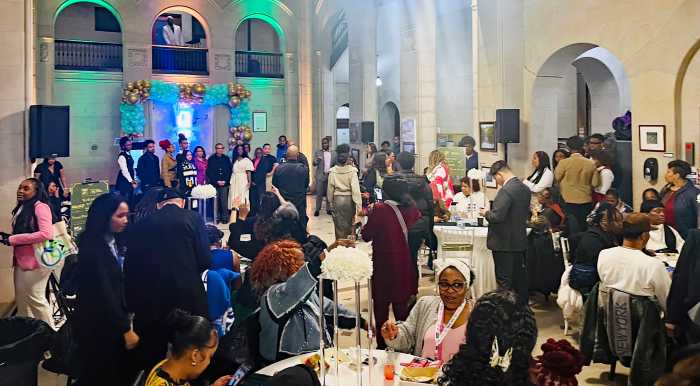
Young professionals gather at Albany City Hall for a networking brunch on Sunday, Feb. 15, 2026, creating opportunities to connect and build for the future.Photo by Orlande Fleury
“We are a city of over eight million people. We’re the wealthiest city in the wealthiest country in the world. But one in four New Yorkers are living in poverty, and one in five cannot afford a MetroCard, all in the same city. As a result, this administration decided that instead of having a typical deputy mayor of Economic Development, we would have a deputy mayor of Economic Justice.
In our city, Black New Yorkers make up about 23% of the population but account for only 2 to 3% of small business owners. That is an immense disparity. We have to ask ourselves why and how we can change it. One of the first steps we took was signing an executive order directing my deputy mayor to consolidate all the city’s fines and fees into a single place so we can begin reducing them by 50%.
The convention schedule ranged from a youth summit and forums to a young professionals’ brunch, networking receptions, policy workshops, and a business expo. Among other things, the gathering’s purpose is to raise money for the association’s scholarship, which is awarded at a scholarship dinner gala on Sunday to conclude the event.
Charlene Gayle, executive director of NYSABPRHAL, told Caribbean Life, “The Scholarship Dinner Gala is the heart of our efforts to support the next generation of leaders. Every dollar raised helps students pursue higher education and achieve their dreams.”
The NYSABPRHAL College Scholarship Program provides annual financial assistance to economically disadvantaged and low- or moderate-income New Yorkers to help make higher education more accessible, awarding scholarships based on a combination of merit and financial need.