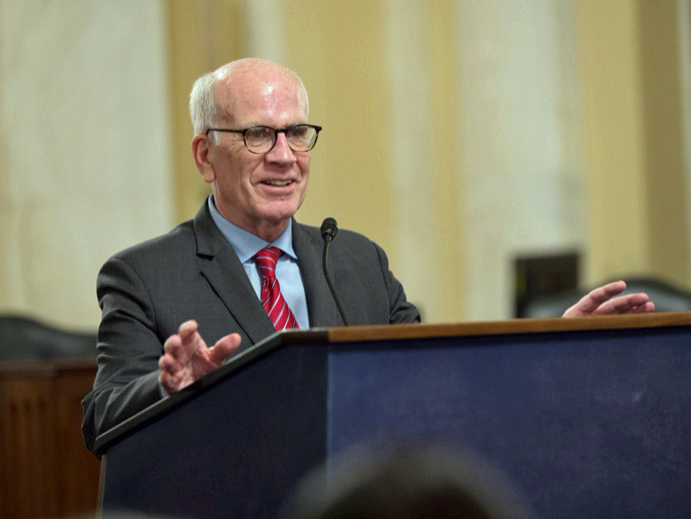
As the United States increases its military presence in the Caribbean, Sen. Peter Welch (D-VT) has expressed concern over President Trump’s deployment of National Guard troops, warships, and fighter jets to the region. Welch warns that these actions signal a significant military escalation.
Welch emphasized in his speech on the US Senate floor that Congress must assert its authority under the War Powers Act before the United States takes further unauthorized military action.
The senator criticized the Trump administration for not providing Congress with enough information about recent military strikes and demanded more transparency and accountability, citing that over 100 people have died from these operations in the Caribbean Sea and the Pacific Ocean.
“The question is: why are our warships, a carrier group, and support assets in the Caribbean? They are not there for drug interdiction,” Welch said. “The reason they’re there is obvious, and it’s even acknowledged.
“President Trump wants Maduro gone,” he added. “He wants regime change. As the president masses our forces for a war—as he and his associates have explicitly stated is one in which their goal would be the elimination of the Maduro regime — the president continues to refuse to come to Congress and seek Congressional approval for a military action, as is required under the War Powers Act.
“All of us as elected members of the United States Senate have vested in us, under the Constitution, Article I, the responsibility and exclusive authority to declare war,” the senator continued. “Let us all accept our duty and demand that the executive be transparent, be accountable, and comply with the provisions of the War Powers Act, and come to Congress for our approval of the military action that is clearly underway.”
In October, Welch voted for a War Powers Act Resolution led by Senator Adam Schiff of California to challenge what he sees as President Trump’s unconstitutional military actions in the Caribbean and pressed the Senate to scrutinize the legal basis for Trump’s military decisions.
Welch said he also led “every Senate Judiciary Committee Democrat in demanding answers from the Department of Justice about the legality of military actions ordered by Trump” that have now killed over 100 in the Caribbean Sea and Pacific Ocean.
With the Trump administration intensifying pressure on Venezuela’s Maduro government, Trump publicly stated on Friday that the US military targeted what he described as a coastal drug facility in Venezuela.
“I don’t know if you read or saw, they have a big plant or a big facility where they send the, you know, where the ships come from,” Trump told reporters. “Two nights ago, we knocked that out. So, we hit them very hard.”
When questioned by reporters on Monday, after meeting with Israeli Prime Minister Benjamin Netanyahu at his Mar-a-Lago estate in Florida, Trump said there was a major explosion at a Venezuelan dock used to load boats with drugs, adding that US forces “hit all the boats and now we hit the area. It’s the implementation area. And that is no longer around.”
“They load the boats up with drugs,” he said, referring to the dock facility in Venezuela. “So, we hit all the boats, and now we hit the area.
“It’s the implementation area,” Trump added. “There’s where they implement. And that is no longer around.”
“It’s the implementation area,” Trump added. “There’s where they implement. And that is no longer around.”
U.S. Rep. Adam Smith, ranking Democrat on the House Armed Services Committee, pointed out that Trump’s latest actions suggest a clear aim to remove Maduro from power in Venezuela.
“What is Trump prepared to do next?” he asked on CNN. “How far is he willing to take this effort at regime change in Venezuela?”
In an op-ed in the Orlando Sentinel, James Martin, a national security expert and Coast Guard veteran, described the US military strikes in the Caribbean as illegal, shortsighted, and counterproductive to American interests.
In an op-ed in the Orlando Sentinel, James Martin, a national security expert and Coast Guard veteran, described the US military strikes in the Caribbean as illegal, shortsighted, and counterproductive to American interests.
“While everyday Americans are working harder for less, Donald Trump and Pete Hegseth (US Defense Secretary) are lighting taxpayer money on fire for political theater, and they are wasting the time and talent of our men and women in uniform,” he said, stating that his experience as “a former US Coast Guard officer who has interdicted drug smugglers on the water, had operational control of multiple US and allied assets executing counter-narcotics missions, and worked on US counter-narcotics policy at the White House informs this opinion.”
Martin noted the administration claims Venezuelan gangs act as narco-terrorists supplying fentanyl to Americans and argues they should be treated as enemy combatants.
He contends most fentanyl reaches the US from Mexico, predominantly trafficked by US citizens connected to Mexican cartels.
He contends most fentanyl reaches the US from Mexico, predominantly trafficked by US citizens connected to Mexican cartels.
Martin stated Venezuela is a minor corridor for narcotics compared to Colombia and Mexico. He said casual observers wrongly assume that military strikes will deter cartels, who simply treat losses as part of business.
“This view is naive; whether a shipment is interdicted or blown up, the cartels treat it as a loss and move to the next load of contraband. They are for-profit organizations, and drug shipments will not stop,” he added.
“What happens to America on our watch is up to us,” Martin continued. “While our government wages reckless strikes in the Caribbean and Eastern Pacific, families across this country are struggling to pay electricity bills, afford health care, and buy groceries.”