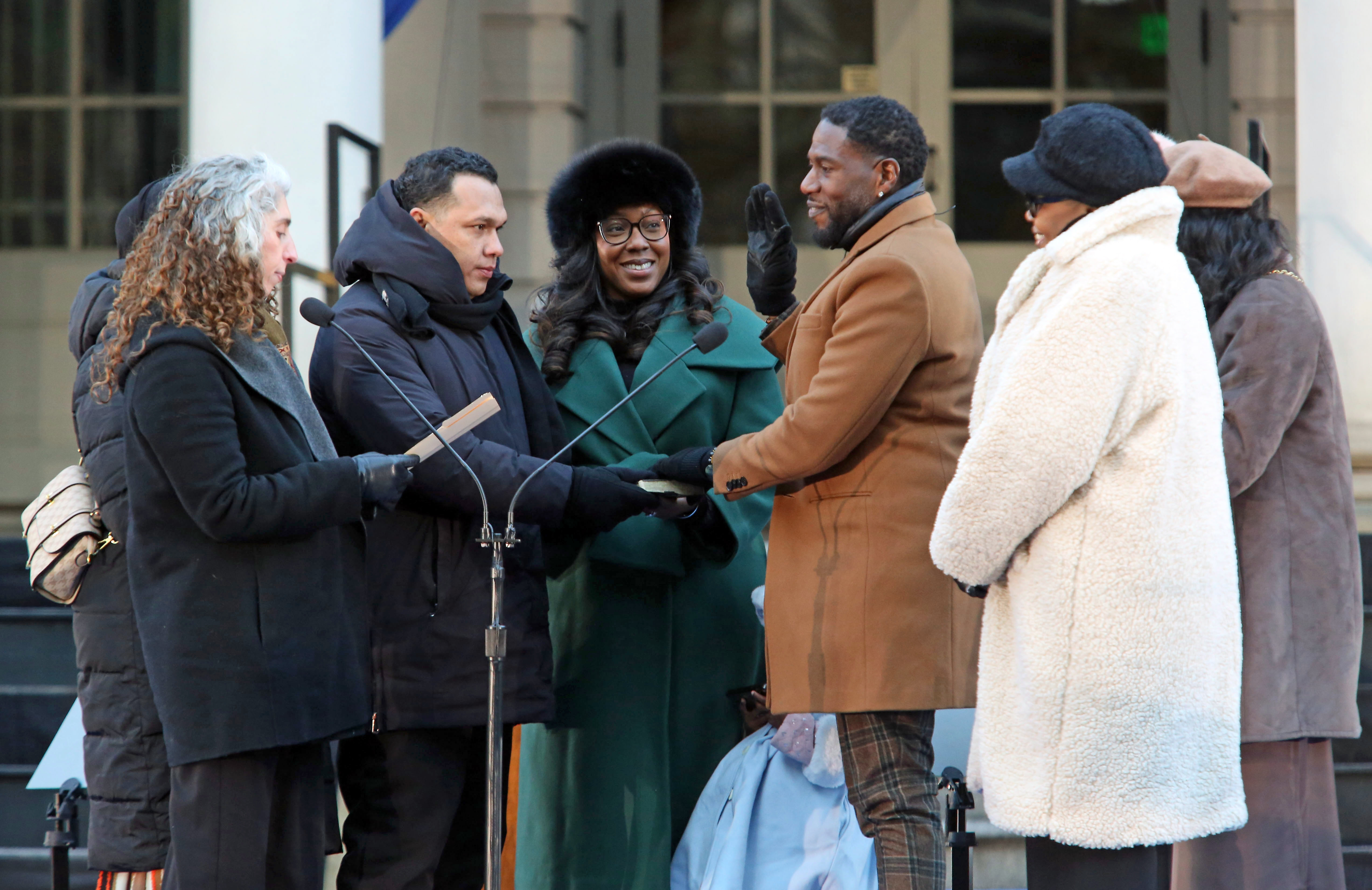
On a bitterly cold day, New York City Public Advocate Jumaane D. Williams, the son of Grenadian immigrants, was inaugurated on Thursday, New Year’s Day, in a City Hall ceremony alongside Mayor Zohran Mamdani and Comptroller Mark Levine.
Williams, 49, a staunch supporter of both Mayor Zohran Mamdani and Comptroller Mark Levine, was sworn in by a group of immigrant New Yorkers, including Amadou Ly, an immigration advocate; the Perez Alnaudes, a family of five seeking asylum whom Public Advocate Williams recently supported at their immigration check-in; and Aissatou Diallo, a longtime New York resident recently detained by federal agents, with whom Williams joined in federal court.
In his emotional, inaugural address on Thursday, Jan. 1, Public Advocate Williams spoke about the ways in which the stories of the immigrant community members represent this moment for the city.
“I want to thank Amadou and these inspiring families for being here at this ceremony, and in New York. I am a son of immigrants myself: my parents came from Grenada over 50 years ago. I was just sworn in on my late father’s Bible, my mother is here today, and I am proud to have my family sitting together with theirs,” he said. “Their stories perfectly capture this moment for our city. The challenges we face, the hardship we endure, and the hope that persists.
“Those realities are often in tension, because this is a time and a place of contradictions,” he added. “One, when even as the federal government drives us to despair, local leadership can invite inspiration. When this celebration at City Hall is only blocks from the tribulation at Federal Plaza. When the relief that these families are still united comes, as so many are being separated. And this sense of contradiction carries across the five boroughs.
“This is a city of enormous wealth and enduring poverty. Of the greed of some, and the generosity of many. Of darkness and of light,” Williams continued. “I’ve seen the darkness, of course, yet I look out on New York today, and I see so much light. These contradictions mean we can at once love our city as it is and challenge its flaws – not as a reason for pessimism, but a call for activism.”
As Public Advocate, Williams said he has tried to be an “activist-elected official, someone who pushes back.
“Now, I see the chance to push forward; to provide accountability aimed at the ideal that government has an opportunity and obligation to do good,” he said. “At the core of public service and progressivism is the principle of making government work, and showing people it can work for them.
“Now, I see the chance to push forward; to provide accountability aimed at the ideal that government has an opportunity and obligation to do good,” he said. “At the core of public service and progressivism is the principle of making government work, and showing people it can work for them.
“That means we need to meet people where they are, show grace instead of ignoring what brought them there, and be honest about why,” he added. “The powers in place would rather create an ‘other’ to blame for our problems than address them, whether it be our immigrant communities, our trans siblings, our homeless neighbors or many marginalized groups.
“Rejecting those ideas means naming the reason that the powers in place perpetuate them – because if we are divided, the status quo stands,” the Public Advocate continued.
“Whether you arrived in our city five generations ago or five years ago or five minutes ago, the reasons so many New Yorkers have too little are not because of the people who have even less, or who have been here for less time. Not because of the people pushed to the bottom, but the systems entrenched at the top.”
Public Advocate Williams said, “That’s where we should focus our anger and our action.”
Public Advocate Williams said, “That’s where we should focus our anger and our action.”
“If we are not driven apart by the divisions of our races or religions or identities, but pulled together by the commonalities in our emotions, our needs, and our humanity, then we can all climb,” Williams said. “I know that the project of New York is possible – that great mosaic described by another mayor who believed in democratic socialist ideals, David Dinkins. Yet the truth of it is – there are people who are rooting for New York to fail. Some couch it in concern, others openly scorn our city, but at the heart of this hate is the truth that our success, that our very existence, belies their core belief that New York is not possible.
“They demonize us because our mosaic challenges their ideology. They want to be right in their cynicism more than they want us to succeed in our idealism. They are driven by the idea that bringing together so many diverse people, cultures, faiths, and identities into a united community is impossible,” he continued. “But New York, we are a shining beacon of possibility. We cross new cultural borders through each subway stop, and are introduced to new experiences through each passenger. Our possibilities come in every language and from every heritage. So do our prayers, so do our people, so does our power.”
Williams said it has been shown it in the face of oligarchy and authoritarianism – “neighbors standing with neighbors across borough and background to defend immigrant communities and feed hungry families.
“We see it in the multicultural mosaic that brought us to this moment,” he said.
“We see it in the multicultural mosaic that brought us to this moment,” he said.
“Even with this great movement, I know that realizing the full potential of our possibilities will not be easy. It never has been.
“Yet, I believe it’s possible to make great progress, because I’ve seen it through my years in the building behind me and the streets before us,” he added. “I have been in our movement, and I have seen things move. The simple truth is that governing is hard, that achievement is exhausting – and I aim to assist my partners in government when possible and hold them to account when necessary.
“Yet, I believe it’s possible to make great progress, because I’ve seen it through my years in the building behind me and the streets before us,” he added. “I have been in our movement, and I have seen things move. The simple truth is that governing is hard, that achievement is exhausting – and I aim to assist my partners in government when possible and hold them to account when necessary.
“I believe in this possibility – that with the people, the tools, the passions, and the compassion that we need, we can meet the moment and create change,” the Public Advocate continued. “We can look into the unknown and see opportunity. That’s the thing about uncertainty – anything can happen – but anything can happen. We could make New York more affordable, more safe, and more just. We could, we can, and we have to try.”
Williams said this optimism toward action is embedded not only in New York City’s history, but also in his own heritage.
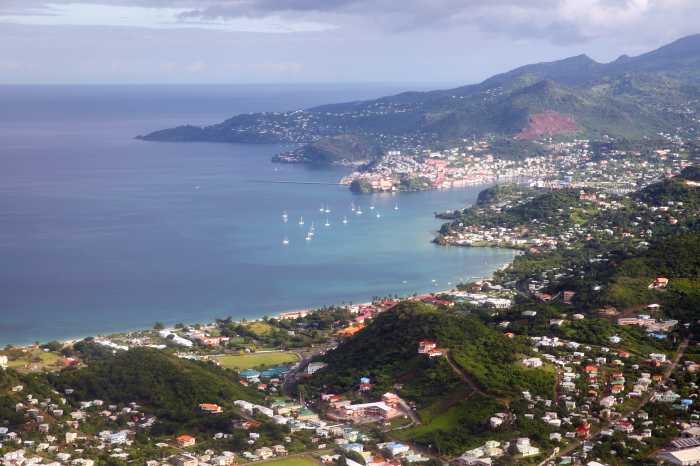
In Grenada, he said slain Prime Minister Maurice Bishop took up the fight for “radical” socialist ideals like housing, healthcare, and education.
“He demanded that we move ‘Forward ever, Backward never,’ and today I echo that call from the ‘Isle of Spice’ to the Island of Manhattan,” Williams said.
“He demanded that we move ‘Forward ever, Backward never,’ and today I echo that call from the ‘Isle of Spice’ to the Island of Manhattan,” Williams said.
He also noted that Bishop cautioned that “revolutionaries do not have the right to be cowards.”
“We can be afraid, but we need the courage to match it,” he said. “There are things to be feared. But there is also reason to hope. Hope is the embrace of possibility. Hope and fear are undeniably connected. Hope is the belief that good can come; fear is the worry that it will not.”
In these contradicting ideals, Williams said New Yorkers are faced with a choice.
In these contradicting ideals, Williams said New Yorkers are faced with a choice.
“I choose to hope. I have faith. But faith without works is dead,” he said. “So today, I’m committing to the work of public service. And I ask every New Yorker to commit their own talents – to use what they have and do what they can for the success of our city and everyone who calls it home.
“I don’t know if, when my Grenadian mother arrived as a teenager, she hoped that a half-century later, her son would speak from these steps. But she could have. Because here in New York City, we choose to celebrate possibility, and work to make it reality,” Williams added.
“I don’t know if, when my Grenadian mother arrived as a teenager, she hoped that a half-century later, her son would speak from these steps. But she could have. Because here in New York City, we choose to celebrate possibility, and work to make it reality,” Williams added.
“I wish I could go back and tell my younger self that – instead, I’ll say it to my daughters today. To the three children of the Perez Alnaude family. To everyone who may question their own worth, or whether it’s worth fighting for this city, with all its contradictions and problems and possibilities.
“As we head into a new year, a new term, I want to ask all of you to take an oath with me. Our neighbors in Brazil adopted a motto that I’ve tried to embody – that ‘No One Let Go of Anyone’s Hand.’ Because if we’re all connected, we can’t lose anyone,” he continued.
“So, we hold onto the hand of our neighbor, and we reach out with our other hand to grasp someone who we fear might slip through the cracks. We bring them along.”
Williams urged everyone who was comfortable to take the hand of the person next to them.
Williams urged everyone who was comfortable to take the hand of the person next to them.
“We can all be the voice of the people,” he said. “I don’t know what’s ahead. But I won’t lose hold. And I won’t lose hope. Anything can happen. So, anything can happen.
“And, as we march forward. No one let go of anyone’s hand,” Williams urged.
“And, as we march forward. No one let go of anyone’s hand,” Williams urged.