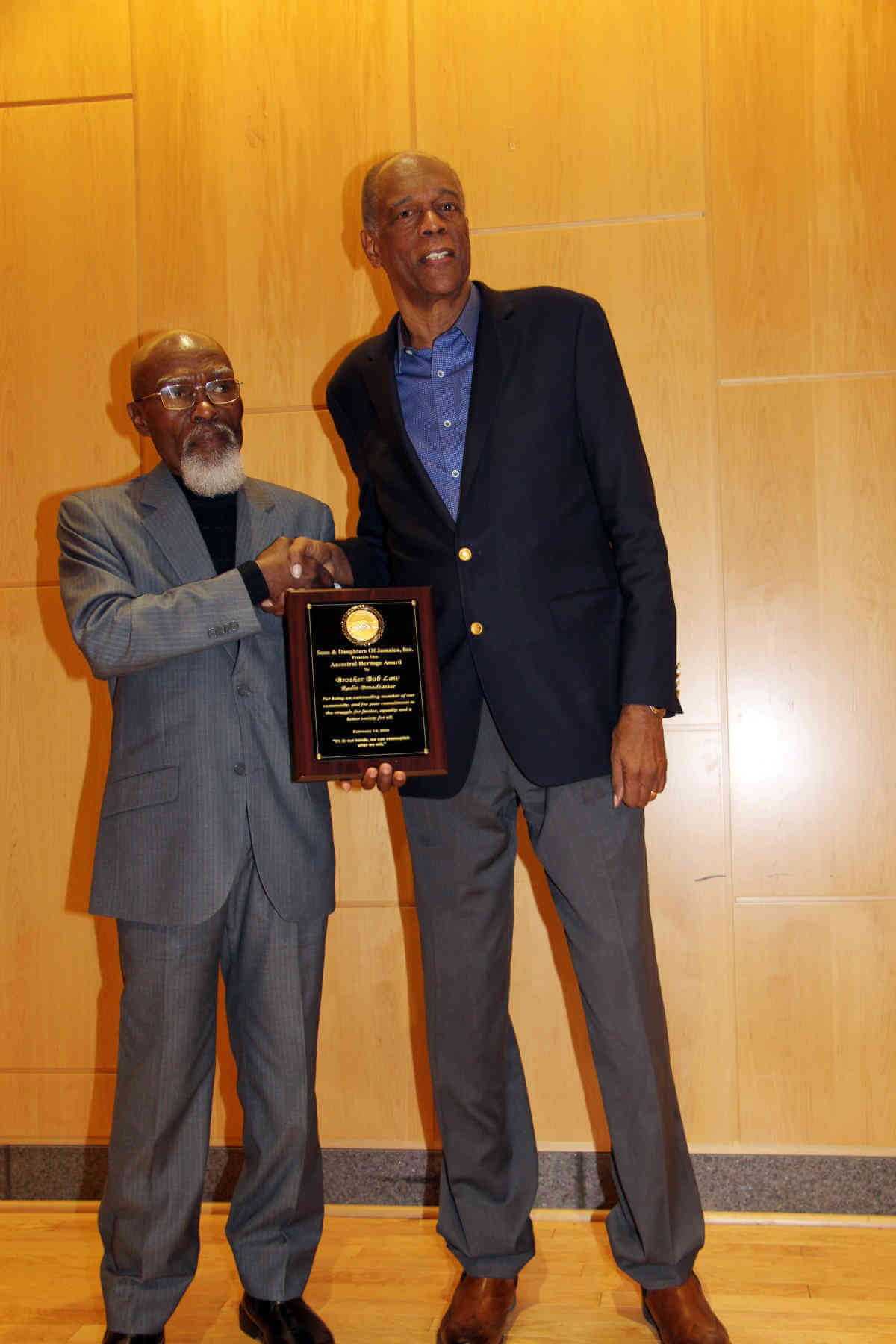
The announcement was confirmed on social media in a statement from his beloved family: “It is with broken hearts that the family of Bob Law, legendary radio broadcaster, community activist and entrepreneur, announces his passing on Monday, March 30.”
According to reports, Law passed away after enduring declining health challenges and daily dialysis treatments.
“I know I haven’t heard him on WBAI for some time, but I can’t believe he’s gone forever,” Lister Hewan Lowe, producer of “Burn, Baby, Burn” (a weekly, early morning show at the progressive radio station) lamented.
His pioneering colleague Gary Byrd — who hosts the Gary Byrd Experience from WBLS-FM and WBAI-FM — dubbed him the ‘tall one.’
“My brother, the tall one, broadcast activist, father, husband, author, filmmaker, and friend, was dedicated to our people until the very end,” Byrd said.
“Though he towered over many who listened and also those he saw, his gift was his love for our people,” Byrd added.
“Now he becomes an ancestor who fills us with pride.”
NY1 described Law as a “ferocious advocate for justice.”
In an audio epitaph, the medium recapped a legacy defined by Law’s midnight to 5 a.m. formula, which fed the appetites of hungry listeners yearning for more than “all the news fit to print.”
Apparently, he joined the station in 1973 when high ratings branded it the sole soul station at the end of the dial.
Building on its reputation, Law amplified the 1600 frequency. He endeared himself to listeners by encouraging them to stay up late to glean alternative opinions on current events.
Many more could reflect a dialogue with Pan-Africanist, Nation of Islam, and Muslim leader Malcolm X.
But, truth be told, insider stories about celebrities Richard Pryor, Sister Souljah, Whitney Houston, James Brown, and others were on his radar as topical commentary.
Face it, Law focused on the diversity of his community.
Credited as a key mobilizer in the convergence of masses from all over the country, Law used his platform as a sounding board for an invitation to the Million Man March.
“He provided the political grapevine of Black America,” Rev. Al Sharpton, founder of the National Action Network, said.
“He was a true representative.”
Whether related to Motown Records’ Berry Gordy, SONY Music’s Clarence Avant, or trailblazing Atlantic Records’ female boss, Sylvia Rhone, Law’s insightful disclosures enhanced understanding of the behind-the-scenes practice.
It was following my lengthy exaltation of a growing presence of Black publicists, promotion personnel, A&R executives, and numerous niche music signees to record labels.
“Sylvia Rhone is the only Black, female executive able to sign checks. That makes her more than a figurehead.”
Right then and there, I realized a lesson in perceptions, corporate facades, and the importance of money management.
He was not always subtle.
Neither was he deluded, jaded, or impressed with popular perceptions.
“He was in a league of his own,” Village Voice reporter Peter Noel said.
“Gone but not forgotten,” Noel added.
In honor, a great many even dimmed the glow.
She was 89.
A May home-going rite is planned.
Harris, Jeffries & Crump represent NAN 35
Three reputable attorneys are among the distinguished speakers scheduled to address National Action Network’s conventioneers, invited to attend a free, three-day gathering at the Sheraton New York Times Square Hotel from April 8.
From a long list of dignitaries asked to participate in the annual confab, the three represent the legal profession and are likely to attract the largest crowds.
Credentials may factor, as may name recognition, but nostalgia permits recalling a statement from a California senator who declared aspirations for a presidential candidacy, saying, ‘Kamala Harris for the people.’
She was denied victory in that case but ultimately won historic notoriety by claiming a win that led to the election of the first Black female vice president of the United States.
Another proponent of due process is Democratic House minority leader Cong. Hakeem Jeffries. Early in his career, he worked as a corporate lawyer.
That the New Yorker once represented corporate entities Viacom and CBS could be perceived as a capitalist ambition for advancement.
He is now the Democratic House minority leader and considered an agitator against unreasonable Republican policies.
Redemption might be evident with a recurring appearance from Civil Rights attorney Benjamin Crump.
Invited again following the travesty surrounding the death of George Floyd, his name indelibly imprints persuasive legal arguments concerning racism in America.
His consistent attention to duty has surpassed skepticism for his sustainability.
More than a mouthpiece and advocate for justice, he qualifies as an asset to any practice, having served as a partner in the law firm Harris, Jeffries & Crump.
Perhaps an unlikely union, though, the three diverse advocates of America’s jurisprudence are among clergy, activists, politicians, entertainers, dignitaries, and ordinary citizens slated for independent appearances at the Manhattan landmark.
Together, they will also mark the 35th anniversary of the founding of the national advocacy Civil Rights organization by activist Rev. Al Sharpton.
While workshops, panel discussions, and open forums are billed, the celebrated three legal wizards will likely attract the lion’s share of participants.
Catch you on the Inside!