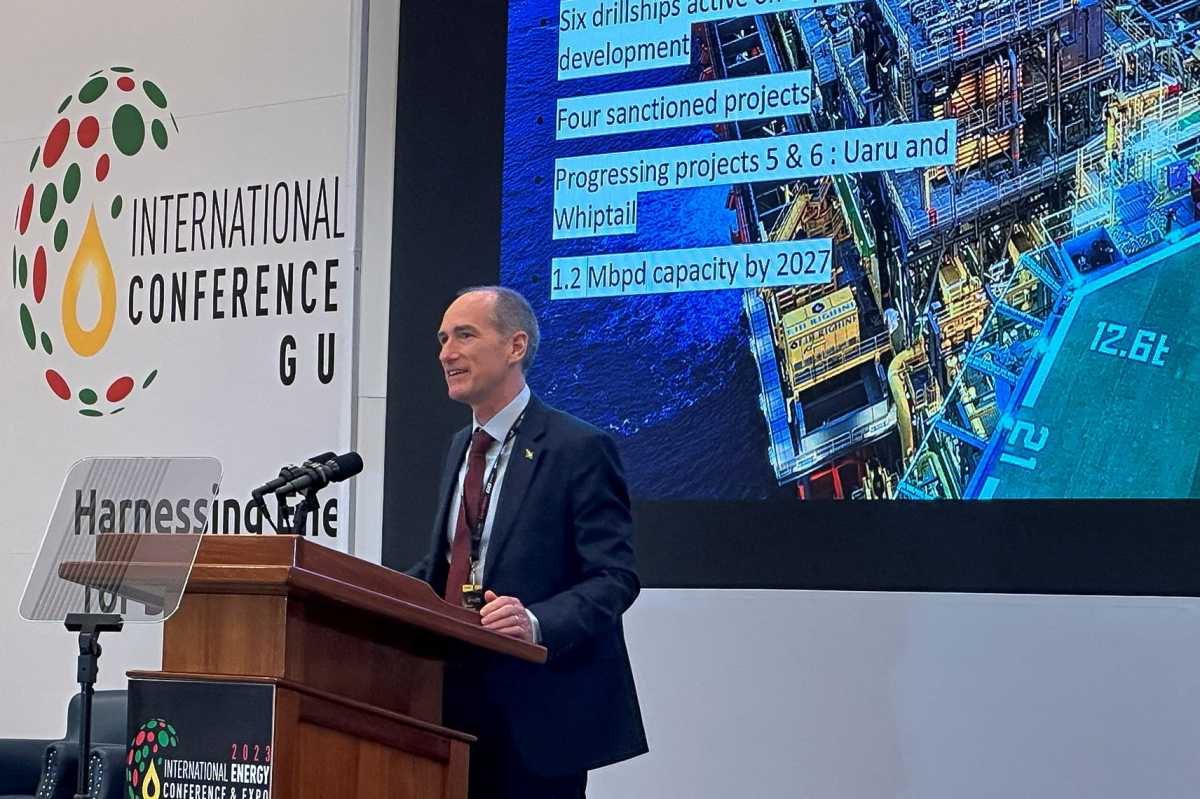
Regional oil exporter Guyana is set to rake in hundreds of millions more in cash both from current higher war-induced global prices and from a greater share of production revenues with US supermajor ExxonMobil and its consortium partners, officials said this week.
Alistair Routledge, the president of Exxon Guyana, told reporters that current higher prices at over $100 per barrel will mean that the company and partners Hess Corp/Chevron and CNOOC of China will recover nearly all of the $60 billion in upfront “historic” costs the company had invested in the country faster than anticipated. The company had initially projected that its offshore investment would have been wiped away sometime next year, with prices at around $60 per barrel, but prevailing prices could trigger a windfall for the Caribbean Community’s most resource-rich member nation and see the initial sum wiped away this year instead of next year.
The current production sharing deal between the government and the consortium allows them to recover up to 75% as cost oil, with the two sides splitting the remaining 25% equally. Guyana also gets an additional 2% in royalty, taking its tally to 14.5%. Routledge says that windfall times are ahead for Guyana if the prevailing situation holds steady in the coming months.
“We were anticipating sometime next year in 2027 that we were going to get to the point where we had recovered those historic costs, probably largely because of just increasing volumes of production that were generating higher and higher revenues to offset the ongoing expenditures plus recover historic costs. If you stay at the current oil price, then it will happen this year based on the level of expenditures and the production that we anticipate, so that’s a significant acceleration. What that then means is that instead of roughly the 14.5% that the country has been receiving by way of revenues into the natural resource fund from the Stabroek Bock production and revenues, what will happen is that percentage will significantly increase,” he said.
The announcement about higher revenues to Guyana comes amidst continuing criticism from opposition parties and civil society groups about the alleged lopsided deal between the company and Guyana, with critics demanding at least up to 10% royalty instead-of the current 2% — and a reduced percentage of the cost recovery percentage from 75 to a lower ceiling.
The country is by far the region’s leading daily producer at around 900,000 barrels per day, followed by Trinidad with nearly 50,000, Suriname at 16,000 and Belize and Barbados with significantly reduced production levels. Fellow CARICOM nation and Guyana’s eastern neighbor, Suriname, is set to commence actual production in 2028, drawing resources from the same general offshore area as Guyana, making the two significant players on the global market. End