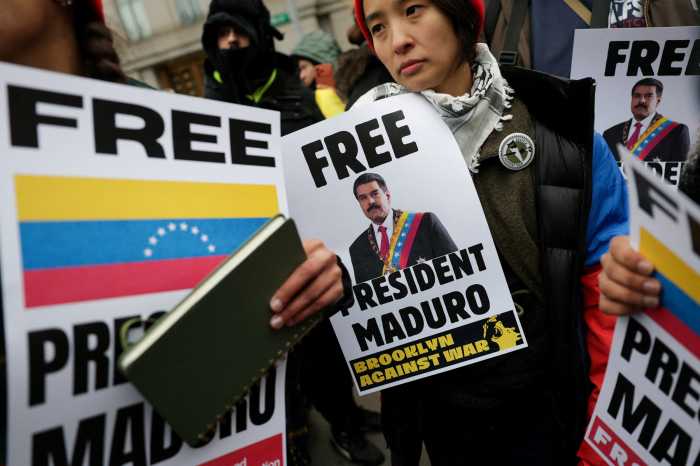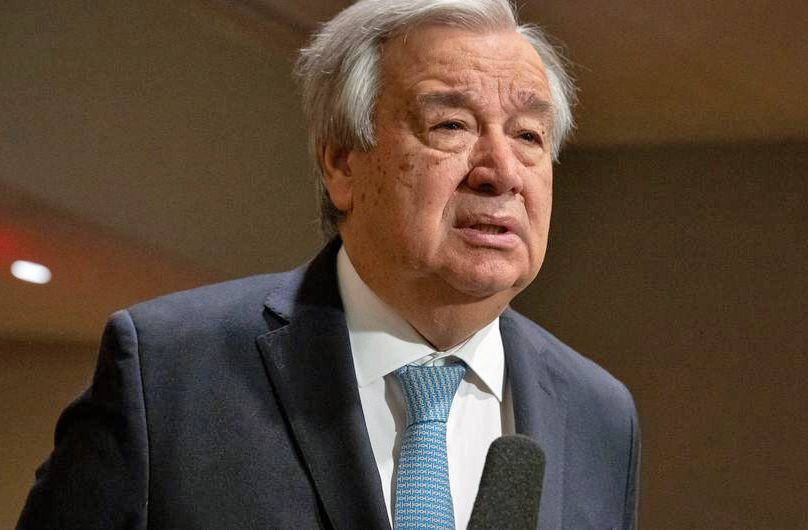
As President Donald J. Trump said early Saturday, Jan. 3, that the US military has captured Venezuelan President Nicolas Maduro amid intensification of military strikes in Venezuela, United Nations Secretary General Antonio Guterres has expressed grave alarm over the escalating conflict.
“The Secretary-General is deeply alarmed by the recent escalation in Venezuela, culminating with today’s United States military action in the country, which has potential worrying implications for the region,” said Stéphane Dujarric, spokesman for the Secretary-General, in a statement.
“Independently of the situation in Venezuela, these developments constitute a dangerous precedent,” he warned. “The Secretary-General continues to emphasize the importance of full respect – by all – of international law, including the UN Charter.
“He’s deeply concerned that the rules of international law have not been respected,” added Dujarric, stating that Guterres “calls on all actors in Venezuela to engage in inclusive dialogue, in full respect of human rights and the rule of law.”
With Saturday’s US military airstrikes in Venezuela and the reported capture of Maduro, Venezuela has requested an urgent United Nations Security Council meeting.
“No cowardly attack will prevail against the strength of this people, who will emerge victorious,” said Foreign Minister Yván Gil Pinto in a letter to the Council.
Colombia’s President Gustavo Petro has also called for emergency meetings of the UN and the Organization of American States (OAS).
“No cowardly attack will prevail against the strength of this people, who will emerge victorious,” said Foreign Minister Yván Gil Pinto in a letter to the Council.
Colombia’s President Gustavo Petro has also called for emergency meetings of the UN and the Organization of American States (OAS).
“The Government of Colombia rejects any unilateral military action that could worsen the situation or put the civilian population at risk,” said Petro in several posts on X, formerly Twitter, adding that Colombia would “adopt a position aimed at preserving regional peace.”
He called for “urgent de-escalation” of the conflict, “urging all involved parties to abstain from actions that deepen confrontation, and to prioritize dialogue and diplomatic channels.”
He called for “urgent de-escalation” of the conflict, “urging all involved parties to abstain from actions that deepen confrontation, and to prioritize dialogue and diplomatic channels.”
Earlier on Saturday, US Senator Mike Lee (R-Utah) said that US Secretary of State Marco Rubio informed him that he “anticipates no further action in Venezuela” with the US military’s reported capture of Maduro.
“He informed me that Nicolás Maduro has been arrested by US personnel to stand trial on criminal charges in the United States, and that the kinetic action we saw tonight was deployed to protect and defend those executing the arrest warrant,” posted Lee on X, formerly Twitter, after he said he spoke directly with Rubio, the son of Cuban immigrants who migrated to Miami.
“This action likely falls within the president’s inherent authority under Article II of the Constitution to protect US personnel from an actual or imminent attack,” he added, stating that Rubio “anticipates no further action in Venezuela now that Maduro is in US custody.”
Lee had earlier expressed skepticism about the US military action.
Lee had earlier expressed skepticism about the US military action.
“I look forward to learning what, if anything, might constitutionally justify this action in the absence of a declaration of war or authorization for the use of military force,” he wrote on X early Saturday.
In confirming US military strikes on Venezuela early Saturday, Trump wrote on his social media network, Truth Social, that Maduro and his wife were “captured and flown out of the Country.
“The United States of America has successfully carried out a large-scale strike against Venezuela and its leader,” he wrote.
“This operation was done in conjunction with US Law Enforcement,” Trump added. “Details to follow.”
Shortly afterwards, the US President described the US military operation as “brilliant.”
“This operation was done in conjunction with US Law Enforcement,” Trump added. “Details to follow.”
Shortly afterwards, the US President described the US military operation as “brilliant.”
“A lot of good planning and lot of great, great troops and great people,” he told the New York Times tersely. “It was a brilliant operation, actually.”
But Senator Ruben Gallego (D-AZ), a US Marine Corps veteran who was deployed to Iraq, characterized US strikes in Venezuela as “illegal.”
“This war is illegal,” he wrote on X early Saturday, adding that it was the “second unjustified war in my lifetime.”
“This war is illegal,” he wrote on X early Saturday, adding that it was the “second unjustified war in my lifetime.”
Both Democratic and Republican legislators have been expressing profound alarm over Trump’s escalating military build-up in the Caribbean Sea under the pretext of combating narco-trafficking.
Trump administration officials have reported that over 125 people have been killed in the Caribbean Sea and Pacific Ocean since the US military attacks began on alleged drug-trafficking vessels in early September.
Venezuelan Vice President Delcy Rodríguez said his government is demanding “immediate proof of life from the government of President Donald Trump regarding the lives of President Maduro and the first lady,” Cilia Flores.
While announcing a state of emergency, the Venezuelan government has also urged nationals to take to the streets to protest the US military strikes.
“People to the streets!” demanded the government in a statement early Saturday. “The Bolivarian Government calls on all social and political forces in the country to activate mobilization plans and repudiate this imperialist attack.”
“People to the streets!” demanded the government in a statement early Saturday. “The Bolivarian Government calls on all social and political forces in the country to activate mobilization plans and repudiate this imperialist attack.”
Meanwhile, some major US airlines have cancelled flights to parts of the region after the US Federal Aviation Administration (FAA) restricted them from flying to some Caribbean islands and territories.
American Airlines said in a statement that it was “aware of the airspace closures in the Eastern Caribbean that were issued in the middle of the night and is closely monitoring the situation with the FAA.
“We are making schedule adjustments as necessary with the safety and security of our customers and team members top of mind,” it added.
JetBlue also said that it has canceled over 200 flights “due to airspace closures across the Caribbean related to military activity.”
It, however, said that flights to the Dominican Republic and Jamaica were not impacted by the FAA prohibition.
JetBlue also said that it has canceled over 200 flights “due to airspace closures across the Caribbean related to military activity.”
It, however, said that flights to the Dominican Republic and Jamaica were not impacted by the FAA prohibition.