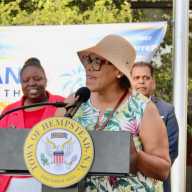
Caribbean-American Democratic Congresswoman Yvette D. Clarke, chair of the Congressional Black Caucus (CBC), on Thursday, May 7, strongly condemned what she describes as the “rigged” Tennessee congressional maps.
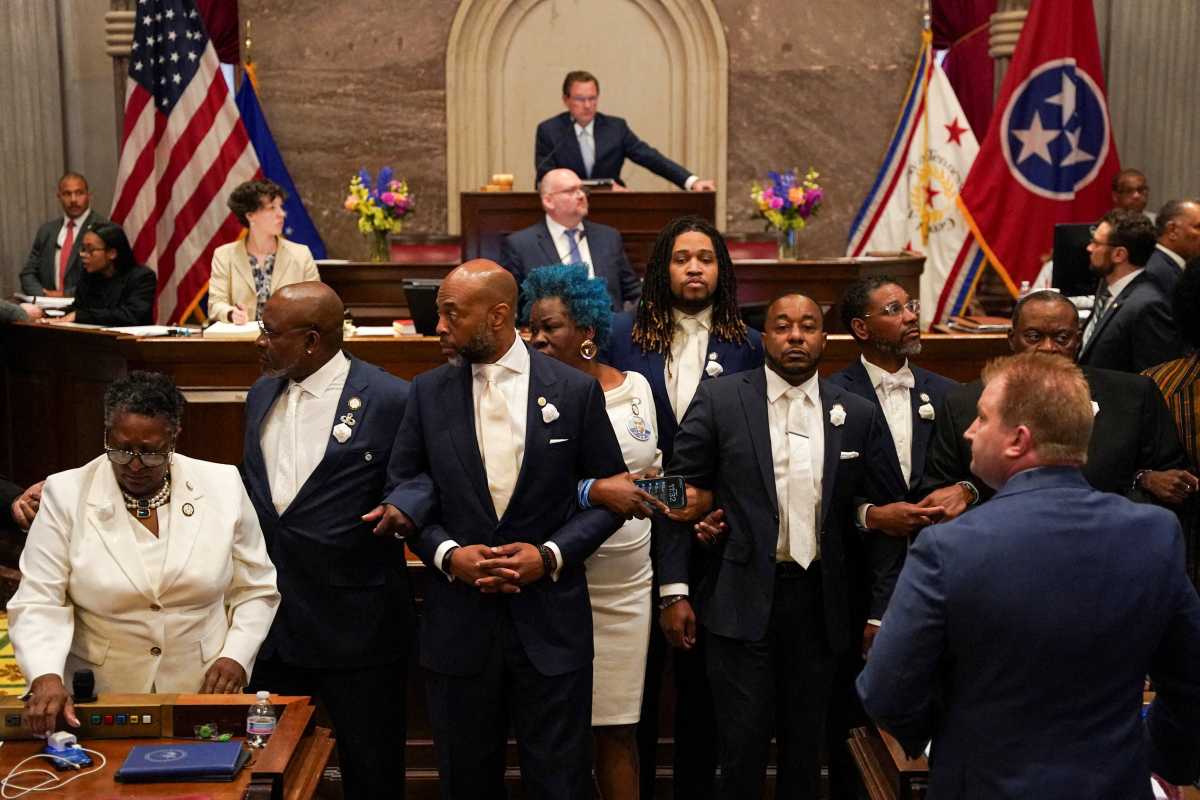
On May 7, Tennessee joined Florida in passing new congressional districts after the United States Supreme Court’s ruling in Louisiana v. Callais gutted Section 2 of the Voting Rights Act (VRA).
Clarke, the daughter of Jamaican immigrants, who represents the 9th Congressional District in Brooklyn, told Caribbean Life that, at President Trump’s urging, Republican Gov. Bill Lee called a special legislative session to adopt a new map dividing Shelby County, including majority-Black Memphis, into three separate districts.
“These same lawmakers even removed a provision in state law requiring voters to be notified when polling places change after redistricting,” Clarke said. “What the Tennessee Legislature did is tantamount to theft — the theft of fair representation and the deliberate stripping away of political power from Black communities.”
“It is an attempt to silence voices and deny Black voters representation reflective of their lived experiences and the issues impacting their communities every day,” she added. “The consequences will not be theoretical; they could have life-and-death ramifications for Black families and communities across Tennessee.”
“As gas prices and the cost of living continue to rise as a direct result of their policies, poll after poll shows Donald Trump and Republicans headed toward defeat in the midterms,” Clarke continued. “They know their only pathway to victory in November is to rig congressional maps in their favor.
“Republicans will stop at nothing in pursuit of single-party rule in Washington, but what they did not expect was a Democratic response this forceful,” she said. “We applaud Democrats in the Tennessee State Legislature for fighting back for fair representation for the people of their state.”
The congresswoman said the Democratic Party is working with partners in state Legislatures in the South, alongside the legal and civil rights communities, to challenge these maps in court and mobilize communities to the ballot box.
Last week, Clarke and Caribbean immigration advocates in New York criticized a ruling by the US Supreme Court on the VRA of 1965.
In a 6-3 ruling in Louisiana v. Callais, the court struck down a majority-Black congressional district in Louisiana, holding that, while the Voting Rights Act could provide a compelling reason to engage in race-based redistricting, it could do so only if plaintiffs can show intentional racial discrimination in the way districts are drawn.
The implications of this ruling include gutting Section 2 of the VRA and allowing states to redraw their congressional district maps to eliminate majority-Black and brown districts previously protected by the VRA, putting them at risk.
“With the stroke of a pen, this rogue, unaccountable court has effectively signed the death certificate of the Voting Rights Act, undoing decades of Black progress,” Clarke said.
“Without the protections of the VRA, Republicans now have the ability to move forward with a nationwide scheme to rig congressional maps in their favor — to manufacture more districts for themselves by eliminating majority-Black districts, while stripping away the ability to challenge those racist, anti-Black maps in court,” she added. “This decision undermines the clear intent of Congress, which established that fair and equal representation is a cornerstone of our democracy, and could open the door for sweeping redistricting changes in the South. Instead, your representatives in Congress can be chosen by the state and imposed on you.
Clarke said the CBC is left with no choice but to bring a legislative solution to the floor of the House of Representatives to protect Black voters around the country from “this extremist effort to diminish Black voices and access to fair representation.
In the SCOTUS ruling, the conservative majority found that the Louisiana district represented by Democrat Cleo Fields relied too heavily on race.
Chief Justice John Roberts described the 6th Congressional District as a “snake” that stretches more than 200 miles in linking parts of Shreveport, Alexandria, Lafayette and Baton Rouge.
“That map is an unconstitutional gerrymander,” wrote Justice Samuel Alito for the six conservative justices.
The Democratic leader of the House of Representatives, Hakeem Jeffries, said that “instead of protecting the ability for American citizens to freely cast their ballot, Republican extremists have embraced voter suppression and racial gerrymandering to desperately cling to power.”
“The corrupt conservative majority on the Supreme Court appointed by Donald Trump has taken a blowtorch to the Voting Rights Act. Why? The extremists need to cheat to win,” said Jeffries, who represents New York’s 8th Congressional District, encompassing parts of Brooklyn and Queens.
Murad Awawdeh, president and CEO of the New York Immigration Coalition (NYIC), an umbrella policy and advocacy organization that represents over 200 immigrant and refugee rights groups throughout New York, said that the “decision from Justice Roberts’ Court is a dangerous step backward for our democracy, weakening what remains of the Voting Rights Act and signaling a retreat from protecting communities that have fought for generations to be heard.”
“By imposing a higher burden to prove intentional discrimination, this ruling weakens federal protections for fair representation and opens the door for states to dilute the political power of historically marginalized communities and deny them fair representation,” said Awawdeh, urging New York to “take immediate action to reinforce New York’s protections against racial discrimination in redistricting and invest in robust enforcement at the state level.
“We look forward to working with our partners in the civil rights and racial justice movement, as well as our state Legislature, to advance the most protective measure possible, so New York can level the playing field and ensure all New Yorkers are fairly represented in Congress,” Awawdeh said.
In 1965, when US President Lyndon Johnson signed the Civil Rights Act into law, he described it as “a triumph for freedom as huge as any victory on any battlefield.”
But Justice Elena Kagan, writing in her dissent, for the court’s three liberal justices, lamented that the “gutting of Section 2 puts that achievement in peril.”
Fields said in a statement that SCOTUS conservative majority decision’s “practical effect is to make it far harder for minority communities to challenge redistricting maps that dilute their political voice.”