Barbados
The Caribbean Development Bank has launched a US$560,000 grant initiative in Barbados to improve access to financing for micro, small, and medium-sized enterprises (MSMEs) and advance private-sector growth.
Led by the Barbados government, the program aims to remove barriers to funding by modernizing legal and financial systems, particularly to support movable asset-based financing and boost private-sector growth.
“This initiative represents a transformative step in modernizing access to finance for Caribbean entrepreneurs,” said Lisa Harding, the division chief at the CDB’s Private Sector Division.
“By enabling movable assets to serve as collateral, we are reducing barriers for MSMEs in Barbados and advancing economic resilience through innovation, a key component of our 10-Year Strategic Plan.”
The CDB says MSMEs account for over 96% of formal businesses in Barbados and are vital to jobs, innovation, and economic growth, but they face a financing gap of more than 77% due to strict collateral requirements.
To address this, the project will introduce a modern Secured Transactions and Collateral Registry (STCR), enabling businesses to use assets such as equipment, inventory, and receivables as collateral to improve loan access.
“By strengthening legal certainty and reducing lending risks, the reform is expected to catalyze the introduction of asset-based lending and other financial products-including supply chain finance, financial leasing, agricultural leasing, and warehouse receipt financing-while expanding inclusion for underserved groups, particularly women entrepreneurs.”
The CDB says modern collateral systems can improve access to credit, reduce borrowing costs, and offer longer loan terms for small businesses.
The project will include legal reforms, system upgrades, and training for financial and legal professionals, while also strengthening asset markets. It is expected to have long-term benefits, especially for women-owned and environmentally focused businesses.
Bermuda
The Bermuda government has paused planned fuel price increases for six months, aiming to ease the financial burden on citizens. Minister of Home Affairs Alexa Lightbourne made the announcement while issuing the Retail Fuels (Consumer Protection Standstill) Ministerial Direction 2026.
The decision prevents an expected rise in gasoline, diesel, and kerosene prices and is meant to help households facing high living costs. The move is also a response to global factors, such as the Russia-Ukraine War and supply disruptions that are affecting energy prices.
“Global oil and refined-product markets have experienced sustained volatility driven by the ongoing war in Ukraine, disruption to maritime shipping routes, and the cumulative effects of climate-related supply shocks.
“For small island economies, they import virtually all of their refined fuel and absorb the full cost of freight, insurance, and currency movement, and that volatility hits consumers harder, faster, and with fewer buffers than in larger markets,” Lightbourne said.
Lightbourne explained the decision to freeze fuel prices was made in consultation with the Regulatory Authority and in close coordination with the Premier and Minister of Finance David Burt.
To make the measure effective, the Ministry of Finance will provide targeted customs-duty relief to licensed fuel importers, covering any verified revenue losses resulting from maintaining unchanged prices.
Lightbourne added that the government will absorb the financial impact, ensuring that consumers are protected from rising fuel costs while also maintaining a stable and reliable fuel supply chain across the country.
Cuba
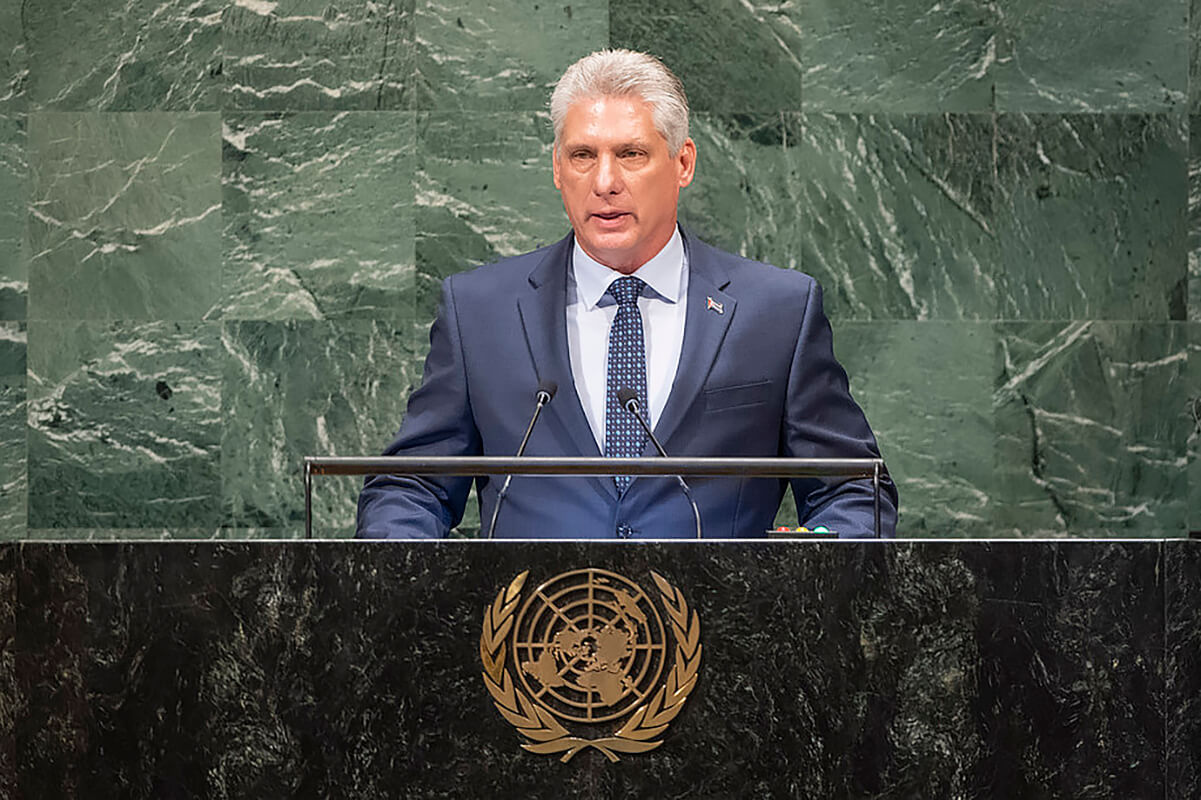
President Miguel Díaz-Canel stated that Cuba does not seek conflict with the United States but is prepared to defend itself if necessary. He made this statement at a rally marking the 65th anniversary of the Cuban Revolution’s declaration of its socialist nature.
“The moment is extremely challenging and calls upon us once again, as on April 16, 1961, to be ready to confront serious threats, including military aggression. We do not want it, but it is our duty to prepare to avoid it and, if it becomes inevitable, to defeat it,” Díaz-Canel said.
Tensions between Cuba and the United States remain high as Cuba faces a worsening economic crisis linked to a U.S. energy blockade. Meanwhile, Donald Trump said his administration may turn its focus to Cuba after the conflict in Iran ends.
“We may stop by Cuba after we finish with this,” he said. He described it as a “failing nation” and asserted that it’s “been a terribly run country for a long time.”
Trump previously has threatened to intervene in Cuba, including military actions in the region (like intervening in Venezuela, which disrupted oil supplies to Cuba) and threatening tariffs on countries that provide oil to the island.
These measures are part of broader pressure to weaken Cuba’s government. U.S. officials, including Secretary of State Marco Rubio, criticize Cuba’s leadership as repressive and demand political reforms —such as releasing political prisoners and liberalizing the economy — in exchange for easing sanctions.
In response, Cuban President Miguel Díaz-Canel rejects these claims, accusing the U.S. of pushing a false narrative to justify its actions.
“Cuba is not a failed state. Cuba is a besieged state. Cuba is a state facing multi-dimensional aggression: economic warfare, an intensified blockade, and an energy blockade,” said Díaz-Canel.
“Cuba is a threatened state that does not surrender. And despite everything. And thanks to socialism. Cuba is a state that resists, creates, and make no mistake, a state that will prevail,” Díaz-Canel added.
Both Cuba and the U.S. have acknowledged that talks are underway to resolve the tension, but no details have been disclosed.
Dominica
Prime Minister Roosevelt Skerrit reported that the Middle East conflict is driving up global prices for food, fuel, and essential goods, affecting Dominica and other small nations.
He described it as a serious global crisis with direct economic impacts on his country, despite its geographic distance.
“Global oil prices have surged, supply chains have been disrupted, and the cost of transporting goods has risen sharply. These pressures are now being felt across economies large and small, with inflationary effects reaching even the most vulnerable countries.”
Skerrit said that in small, import-dependent countries like Dominica, external shocks can quickly raise the cost of food, fuel, and other essential goods.
“We are, in many ways, innocent bystanders affected by a conflict not of our making, but we must not be passive in protecting our citizens from its consequences,” he told legislators, noting that late last month the government committed to a series of targeted relief measures.
“Today, we deliver on one of those measures. We are extending the waiver of Value Added Tax (VAT) and import duties on a range of essential goods until July 2026,” Skerrit said, reiterating “these are difficult times.”
“Global forces threaten to erode the purchasing power of our citizens, so the government is taking decisive action to stabilize the cost of living for all citizens. Families have challenges in meeting the rising cost of basic necessities, so this government is acting with urgency and empathy”.
Skerrit said the government adopted the policy despite opposition, citing interpretations of the International Monetary Fund report.
The IMF noted that Dominica’s economy grew by 4.5% in 2025, with inflation easing to 2.3%, though the current account deficit remained high due to construction imports. Growth is expected to average 3% in 2026–27, supported by infrastructure investment, before slowing later. The deficit should improve as tourism grows and imports decline, especially as geothermal energy develops.
However, the IMF warned that risks remain high due to global conflicts, trade tensions, uncertainty over CBI revenues, and natural disasters.
Guyana
The Government of Guyana has called for investors to participate in energy projects in Wales, as part of its gas-to-energy initiative.
The call focuses on two projects located near the Wales Gas-to-Energy Combined Cycle Power Plant and Natural Gas Liquids (NGL) facilities: the Guyana Ammonia and Urea Plant, valued at US$300 million, and the Guyana Gas Bottling and Logistics Company, estimated at U.S.$40 million.
“For GAUP, the government is targeting investments of up to five million U.S. dollars per investor, while the GGBLC project has a cap of one million U.S. dollars per investor. However, interested parties may indicate higher investment amounts,” the statement said.
The statement said both projects will be privately operated and will provide a government-guaranteed annual return of 10% to investors.
“We encourage all investors to apply, but we will prioritize Guyanese investors, including those in the diaspora.
“Interested investors are required to submit detailed information, including ownership structure, identification, and proposed investment terms, as part of the expression of interest process,” the statement from the Office of the Prime Minister noted.
Submissions must be sent to the National Procurement and Tender Administration Board by May 15, 2026.
“The government noted that the current call is preliminary and will inform the structuring of final investment terms ahead of a formal invitation,” the statement added.
Jamaica
Minister of Tourism Edmund Bartlett said Jamaica’s strong recovery after Hurricane Melissa shows “resilience in action,” with over 1 million visitors and U.S.$956 million in earnings in early 2026.
He also credited the Jamaican diaspora for helping maintain global confidence in the country during its recovery.
“Before a traveler ever books a ticket, before they see a brochure or a campaign, they often hear about Jamaica through you,” Minister Bartlett said, “You are among our most powerful ambassadors, and I mean that in the most literal sense.”
Edmund Bartlett said Jamaica’s strong tourism performance was intentional, crediting the diaspora for maintaining a positive image and preventing negative perceptions after Hurricane Melissa.
These figures speak to the destination’s resilience and the global support our island continues to receive. The world is confident in our ability to recover from disruptions and deliver top-class hospitality at every level,” the minister said.
He said Jamaica’s story will be defined by resilience, authenticity, and strength rather than disruption.
Compiled by Devika Ragoonanan