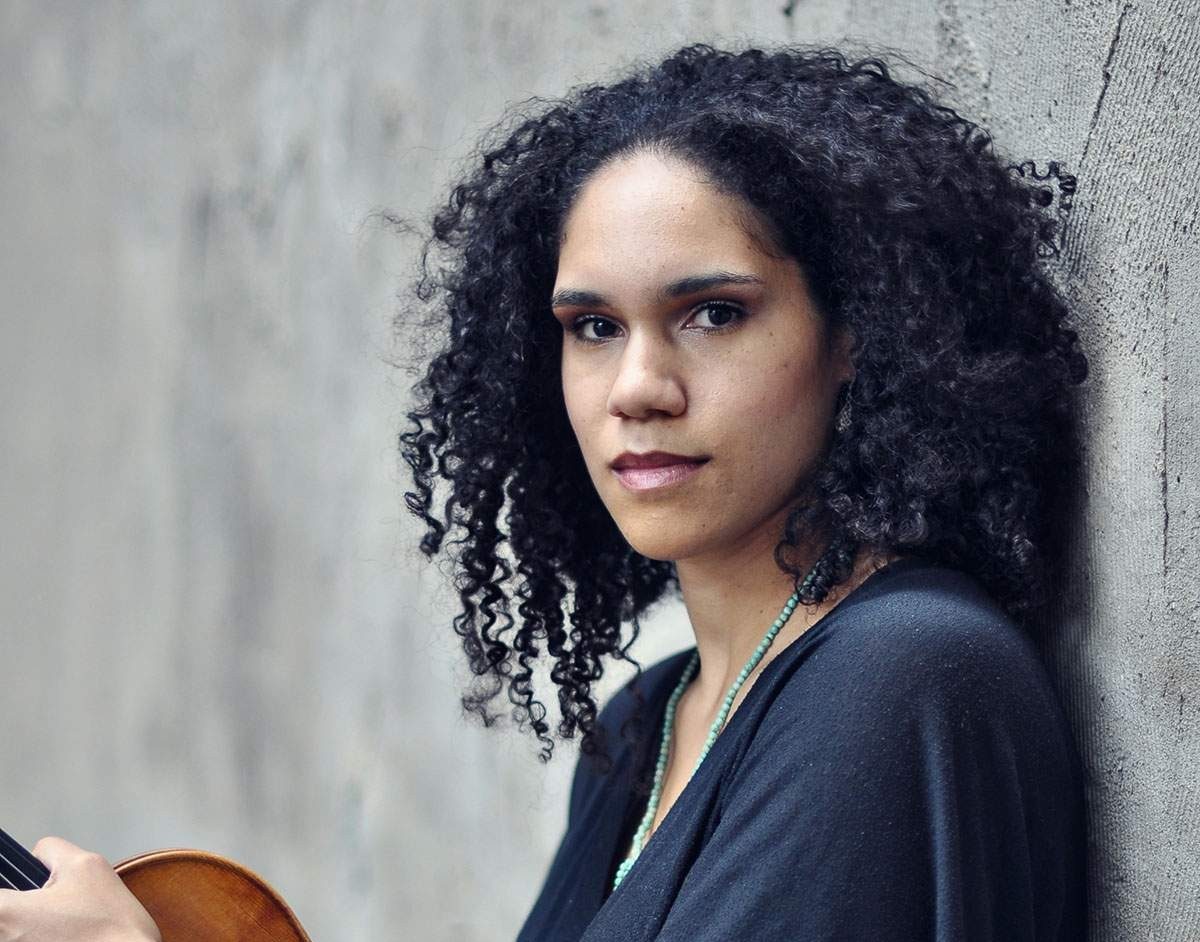
Late last month, violinist and composer Jessie Montgomery taught a Mentor Session to students from the Special Music School at the Kaufman Music Center (KMC), where she is an artist-in-residence for the 2025-2026 season.
As one of the NYC-based performing arts and education non-profit organizations, according to its website, KMC believes that: “Music is essential to the human experience and a vital component of education for everyone.” This is why they focus on stimulating appreciation of and participation in music through performing and educating in ways that awaken creativity and advance innovation.
Montgomery grew up on the Lower East Side of Manhattan in the 1980s, in a deeply artistic household.
Both her parents were artists, one in theater and one in music, so she spent a lot of her childhood backstage, in rehearsal halls, and in performance spaces. “Being constantly surrounded by the arts shaped my understanding of creativity from a very early age. It wasn’t something I had to seek out, it was simply part of everyday life,” she said.
Growing up at that time, there was a strong culture of activism in the community, especially around issues like housing and social justice. Since her parents were actively involved, she often attended rallies and demonstrations.
“What I remember most is the art at all those events,” she added. “There were always these incredible puppets, costumes, bands, dancers. Artists everywhere, just showing up and making the moment feel real. That stayed with me. This idea of a lot of things happening at once, all for the sake of community and everyone’s wellbeing. It’s something I think about a lot, still.”
As a Black American woman, there have been many important influences at different stages of Montgomery’s life, but one pivotal figure was composer Joan Tower.
“She’s a really well-known American composer, and one of my first serious opportunities as a composer was getting to work with her around 2008,” Montgomery shared. “Up until then, I had spent many years focused on performance. That experience really changed my trajectory. After working with her, I decided to return to school to formally study composition. I kept performing after that, but that was the moment I committed to composing professionally.”
Her interest in wanting to be a violinist was actually quite random. She was four years old and it just looked cool to her to play, but she didn’t have any particular connection to the instrument before that. Fortunately, she had a wonderful teacher who helped her fall in love with the instrument, and she added that a lot of times that’s really what it comes down to.
Montgomery began her violin journey on a very traditional classical path, performing in string quartets and touring. Over time, she became more serious about composition, so she started shifting her focus.
“Composing opportunities grew, so I gradually shifted more of my time in that direction, but I never stopped performing,” she explained. “More recently I created an ensemble called the Everything Band, which is really where all of it comes together: performing, composing, improvising, collaborating. It represents where I am now creatively, combining all aspects of my musical identity into one space.”
For her, the composing journey began around junior high school, and between 2005 and 2008, she began doing it professionally. Some of her earliest works were written for students in programs where she was teaching.
“Then in 2008, I wrote Voodoo Dolls, followed by Strum in 2009,” Montgomery said. “Both are string quartets and became widely performed. I got lucky with those two right out of the gate. They are rhythmic, energetic pieces that are still played frequently at festivals and concerts.”
Two years ago, Montgomery won her first Grammy Award for Best Contemporary Classical Composition. She said it was great to work on that project because it involved longtime collaborators and friends like Awadagin Pratt and the musical ensemble A Far Cry.
“I have always admired A Far Cry as an ensemble since they started in the early 2000s when I was living in New England,” she said. “To finally get to make something with them, after all that time, and stack all of that shared history into one piece, was really special. Winning the award felt like a beautiful acknowledgment of work that already held deep personal significance. It doesn’t change why you create, but it does affirm that the work is resonating.”
In addition, at that time, Montgomery also finished a three-year experience as the Mead Composer-in-Residence for the Chicago Symphony Orchestra. She felt it was transformative, because while she had composed works for orchestra before, this was her first time being deeply embedded within an orchestral institution over several years.
“Orchestras are the most visible face of classical music. It gave me insight into how orchestras function, both artistically and structurally. Part of my job was curating their new music series, which I loved. I got to bring in composers who were new to me and new to Chicago audiences, and it really sharpened my curatorial instincts. I also developed a strong connection to the city of Chicago, which I now call home,” she added.
Additionally, Montgomery has also been a part of community-centered projects like Blacknificent 7. She expressed how this helped expand her understanding of artistic leadership, and how meaningful it is having the diversity in how the composers, who are from different parts of the country, explore Black culture and musical identity in unique ways.
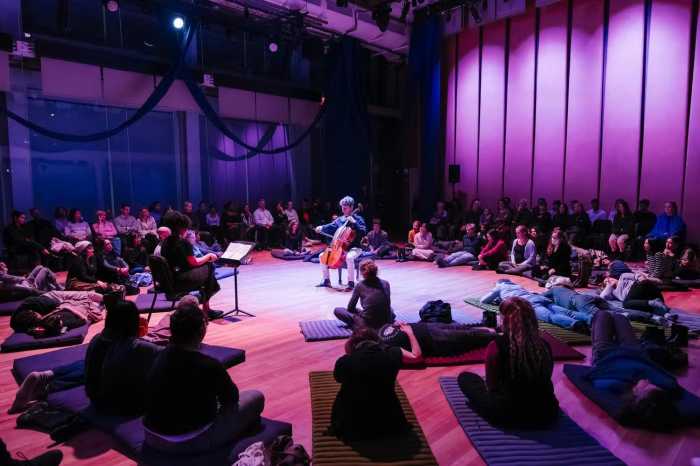
She also said having community and support from each other is extremely valuable because of how challenging it can be to navigate having a life in the arts industry. The heart of the residency with Kaufman Music Center is the work with the Everything Band, which Montgomery leads, with a group-led focus. According to her, when the band is actually making music together, everyone’s voice matters and gets taken into account. She and her band performed at the KMC on Friday, May 1.
Discussing her approach to mentoring young artists and how she’s applying it to this residency, Montgomery stated: “When I teach, I’m less focused on how to do the thing and more on how to think about what you’re doing. With the students at Kaufman they’re working from their own motifs, and I guide them in shaping and developing those ideas. I encourage students to ask questions, take risks, trust their ideas, and use feedback to their advantage.”
She expects full participation and she has already seen the students showing up in such an incredible way, and we haven’t even had our first full session yet.
Though Montgomery is still building her legacy, she’d want it to be about freedom. “The ability to choose what I wanted to do and to pursue it fully. That feels simple but it’s not, especially for young Black kids who are navigating real obstacles that other people don’t have to think about,” she said.
For young people, especially those from underrepresented communities, Montgomery hopes to demonstrate that while there may be obstacles, you are not alone.
“It’s important to take up space, ask questions, and develop your own vision. The arts play a vital role in that process. They give you a way to imagine something and bring it into reality. Once you experience that, you begin to believe it’s possible in other parts of your life as well,” she stated.