Antigua and Barbuda
Prime Minister Gaston Browne announced that Antigua and Barbuda will hold its next general election on April 30, 2026, urging supporters of the ruling Antigua and Barbuda Labor Party to secure a decisive victory by winning all 17 constituencies.
The announcement followed the issuing of the election writ by Governor General Sir Rodney Williams.
Speaking at a political rally, Browne framed the election as a pivotal moment, calling on voters to unite and move forward together. He also declared that if his party wins, the day after the election will be observed as a public holiday to celebrate Labor Day.
“This is your renaissance. Let us stand together. Let us move forward together. Let us win together. Say with me a last time, ‘Labor, labor, labor, labor. May God continue to bless you. Much love and blessings,” the ABLP political leader said.
The election is expected to be mainly contested between the ABLP and the opposition United Progressive Party, as one other political party, the Democratic National Alliance, has already announced it will not participate.
In the previous general election held on Jan. 18, 2023, the ABLP won 9 out of 17 seats, while the remaining seats went to the opposition and one independent candidate, Asot Michael.
However, after Michael’s death in November 2024, his seat was filled by Rawdon Turner of the ABLP following a by-election in January 2025.
Barbados
CEO of Barbados Tourism Marketing Inc., Andrea Franklin, said that Barbados being internationally recognized as one of the safest destinations in the Americas and Caribbean for 2026 is both encouraging and reassuring.
“This recognition comes at a particularly significant time in the global tourism environment, as travelers are increasingly discerning and mindful of their choices amid a complex geopolitical landscape.
“This recognition helps to further position Barbados as a destination that offers a safe, stable, and reliable experience. As a destination, we must remain committed to maintaining the standards that continue to earn the trust of those who travel here,” she said following the announcement by Travel & Tour World.
She explained that this recognition comes at an important time, as travelers around the world are becoming more careful and selective about where they visit due to global uncertainties. Because of this, being seen as a safe and stable destination helps strengthen Barbados’ reputation and attract more visitors.
Franklin noted that this achievement is not accidental but the result of years of careful planning and investment in making Barbados a secure, welcoming, and high-quality destination. She emphasized that the people of Barbados play a major role in this success, as their friendliness, professionalism, and strong sense of hospitality help create a positive experience for visitors and set the island apart internationally.
She also pointed out that safety cannot be taken for granted. Instead, it requires continuous effort and shared responsibility from both the government and citizens.
Franklin highlighted that Barbados experienced a record-breaking year for tourism in 2025, welcoming over 729,000 long-stay visitors. This represented a 3.3% increase compared to 2024, with much of the growth coming from the United States market.
Overall, Barbados’s recognition as a safe destination supports its ongoing success in the tourism industry and reinforces the importance of maintaining high standards for the future.
Caribbean
Business leaders in the Caribbean say online learning is becoming an important solution as workers face challenges in accessing higher education overseas.
Martin Cave, executive director of the Antigua and Barbuda Chamber of Commerce, is encouraging employers to support staff in pursuing flexible online education so they can improve their skills without leaving their jobs.
He explained that traditional education options, such as attending institutions like The University of the West Indies or studying abroad, can be challenging due to costs, family responsibilities, and time away from work.
Online programs help remove these barriers by allowing people to study from home and balance their schedules.
Cave emphasized that investing in employee education benefits businesses by improving productivity, efficiency, and overall performance. He also noted that these benefits extend to the wider economy, contributing to national growth, job creation, and economic stability.
Overall, he believes online education is a valuable and practical investment for individuals, businesses, and the Caribbean region as a whole.
Haiti
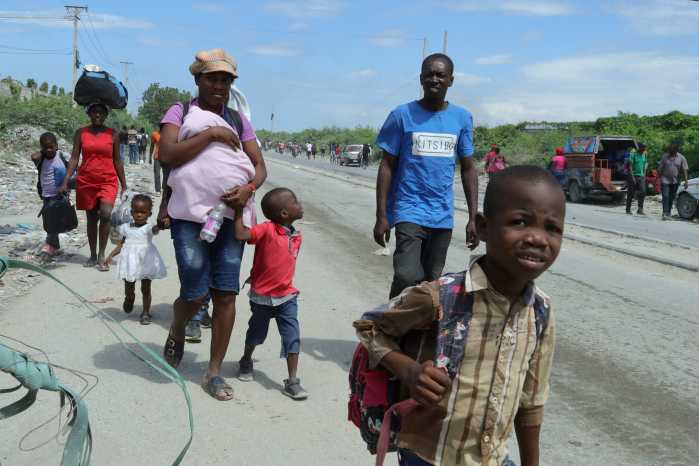
The World Bank reports that Haiti has faced multiple ongoing challenges over the past five years, including health crises, natural disasters, and insecurity, all of which have negatively affected the well-being of its people.
In its latest Latin America and the Caribbean Economic Update, the World Bank explained that conflict and social unrest have made it hard to collect reliable data through normal face-to-face surveys. As a result, researchers relied on six rounds of telephone surveys conducted between 2021 and 2025 to better understand how Haitians are living, including their access to jobs, services, and basic needs.
One of the most concerning findings is the sharp increase in food insecurity. Even though the effects of the COVID-19 pandemic have eased, access to food has continued to decline.
The report revealed that by 2025, about three-quarters of Haitians were living in households where at least one adult had gone without food for an entire day within the past month. This is a significant rise compared to about half of households in 2021.
Overall, the report highlights a worsening situation in Haiti, where economic hardship, instability, and limited access to essential resources are making it increasingly difficult for people to maintain a stable and healthy standard of living.
Jamaica
Minister of Tourism Edmund Bartlett is calling for the creation of a dedicated Caribbean tourism bank to better support investment in the region’s tourism sector, adding that the Caribbean has long struggled because it lacks a financial system specifically designed to meet the needs of tourism, which he describes as a powerful and fast-growing industry.
Bartlett has urged the Inter-American Development Bank (IDB) to take the lead in establishing this institution, as he explained that it could create specialized financial products and provide funding tailored to the unique demands of tourism businesses in the Caribbean.
He made these remarks during a meeting with IDB officials in Washington.
He also addressed the region’s hesitant attitude toward tourism investment, linking it to historical and psychological factors.
Bartlett said there needs to be a shift in mindset, or “psychological decolonization,” so that tourism is seen not as a leftover of colonialism but as a strong, independent driver of economic growth.
He emphasized that tourism can transform communities by creating jobs, improving infrastructure, and boosting local economies.
Bartlett highlighted how tourism has already helped develop many communities across Jamaica and the Caribbean by bringing roads, water, electricity, and new opportunities.
He also reaffirmed the government’s commitment, led by Prime Minister Andrew Holness, to ensure that the benefits of tourism reach ordinary citizens.
Bartlett believes that creating a tourism bank would encourage greater private investment, strengthen the region’s capacity to address challenges such as climate change, and support long-term economic growth across the Caribbean.
Compiled by Devika Ragoonanan